

Longevity—Blessing or Curse?
The 100-Year Life by Lynda Gratton and Andrew Scott

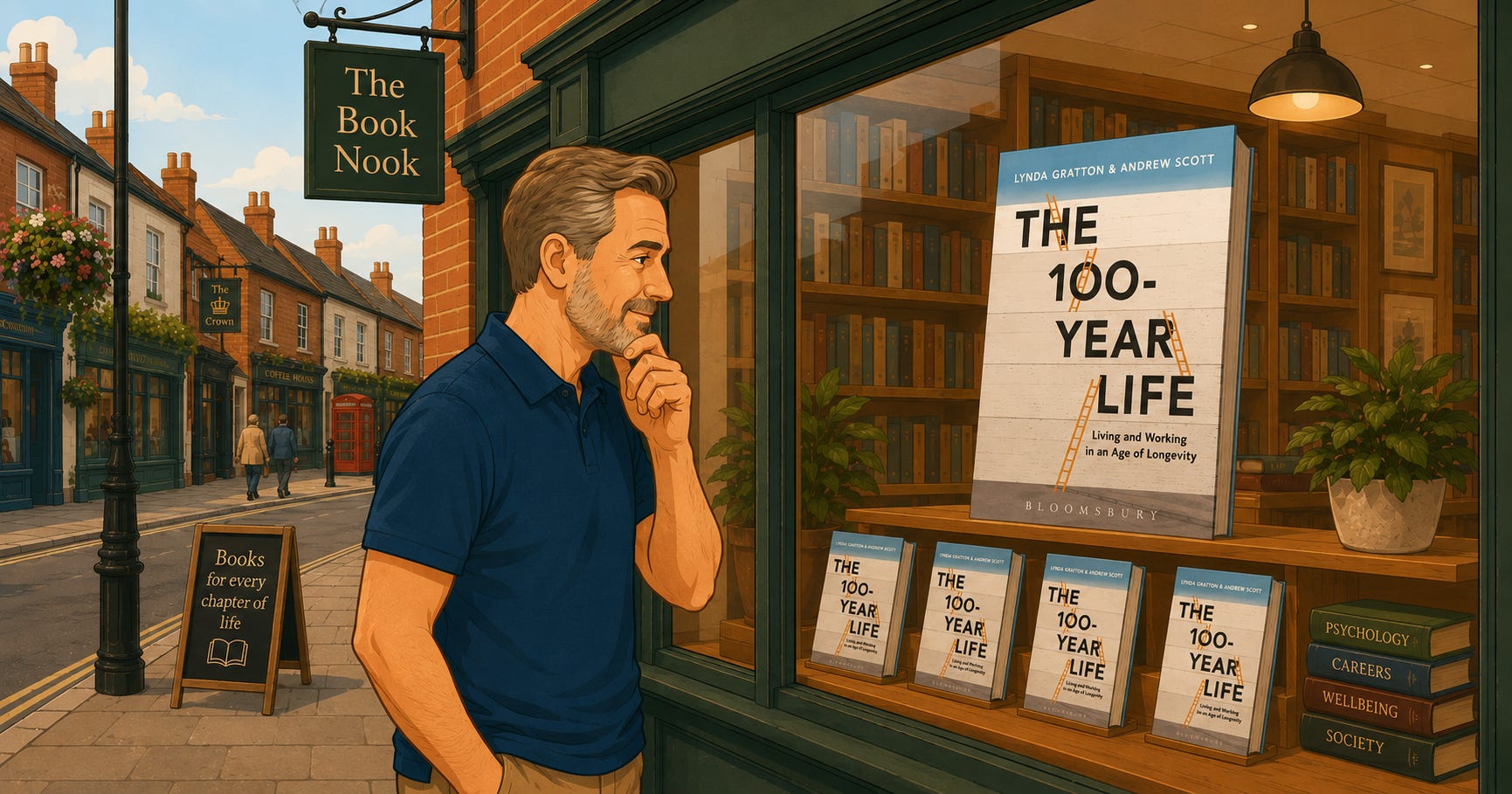
Most of us carry around a mental model of life that was designed for our grandparents. You go to school, get a job, work for forty years and then retire. The trouble is that this model was built for a world where people lived shorter lives, often worked for a single employer and spent relatively few years in retirement before shuffling off the mortal coil.
In The 100-Year Life, Lynda Gratton and Andrew Scott argue that increasing longevity is not simply a health issue. It’s a fundamental shift in society that will affect how we learn, work, save, spend, build relationships and think about our future. This isn’t really a book about living to 100. It’s a book about what happens if you do.
The book in a nutshell
The authors argue that many people born today have a realistic chance of living to 100. That extra time creates enormous opportunities, but it also creates challenges that previous generations never had to face. The traditional three-stage life of education, work and retirement starts to break down when retirement itself may last thirty years or more.
Instead, life becomes multi-stage. People will need to learn throughout their lives, change careers more than once, take periods of reinvention and invest not only financially but also in health, skills, relationships and personal resilience. The central message is that longer lives require longer-term thinking.
The big idea
Many discussions about ageing focus on problems such as pensions, healthcare costs and the economic burden of an older population. Gratton and Scott take a more optimistic view. They see longer life as one of humanity’s greatest achievements and argue that the challenge is not the extra years themselves, but learning how to use them wisely.
If you expect to live into your nineties or beyond, you can no longer think of life as a straight line. Education is no longer something you finish in your early twenties. Career development doesn’t stop at sixty-five. Personal growth becomes a lifelong project rather than an optional extra. In a world of longer lives, reinvention becomes normal rather than exceptional.
Three things that stood out for me
1. Health is a valuable asset
One of the most useful concepts in the book is the distinction between tangible and intangible assets. Tangible assets include things such as savings, pensions and property. Intangible assets include health, friendships, reputation, knowledge, emotional resilience and personal networks.
Reading the book through a healthspan lens, this felt particularly important. Many people spend decades building financial wealth while wrecking themselves physically to achieve it. Without fitness, cognitive health and independence, extra years can become something to endure rather than enjoy. A longer life only becomes a valuable if you remain fit and well enough to enjoy it. I found that out the hard way.
2. Retirement may be the wrong goal
The traditional vision of retirement involves working hard for forty years and then stopping completely. The authors argue that this model may become increasingly unrealistic, both financially and psychologically, as average lifespans continue to increase.
Instead, many people may move between periods of work, learning, leisure and reinvention throughout their lives. For some, purpose and contribution may matter just as much as income. The goal may not be retirement itself, but having the freedom to choose what comes next.
3. Reinvention will be a key skill
One of the strongest themes running through the book is the importance of transitions. Most of us prepare for exams, jobs and retirement, yet very few prepare for reinvention.
In a longer life, the ability to learn new skills, adapt to changing circumstances and create a new identity may become one of the most valuable capabilities we possess. The people who thrive may not necessarily be the smartest or wealthiest. They may simply be the most adaptable.
What I took from the book
The book reinforced something I come back to repeatedly in Olderland: longevity and healthspan aren’t the same thing.
Medical advances may help us live longer, but what determines whether those extra years are enjoyable is how we spend the decades beforehand. If you expect to live another twenty-five or thirty years after 65, investing in strength, fitness, mobility, sleep, nutrition and social connections stops being a hobby. It becomes one of the most important long-term investments you can make.
The authors focus heavily on financial planning, which is entirely understandable. My version would add a parallel question: are you investing enough in the body and mind that will carry you through those extra years?
What you can do
You don’t need to redesign your entire life after reading this book. A better starting point is to ask yourself a few simple questions.
What assumptions are you making about ageing that you inherited from previous generations? Many of those assumptions were formed when people routinely lived shorter lives and had fewer healthy years.
What assets are you building? Not just financial assets, but also health, strength, knowledge, relationships and purpose. Like money invested over time, these assets tend to compound.
And what could you learn next? The idea that education ends in early adulthood is becoming increasingly outdated. In a 100-year life, learning may be one of the most valuable habits you can develop.
The one thing to take away
A longer life is not simply more of the same. It changes the arc of life itself.
The people who benefit most from longevity will not necessarily be those who live the longest. They’ll be the people who adapt early, continue learning, invest in their health and deliberately build lives that can evolve over time.
Who is the book for?
This book is ideal for anyone who wants to think more deliberately about the second half of life. It will appeal to people approaching retirement, mid-career professionals considering a change of direction, parents wondering what longer lifespans may mean for their children, and anyone interested in the relationship between longevity and healthspan.
If you’re looking for a book about supplements, biohacking or anti-ageing tricks, this isn’t it. If you’re interested in how longer lives may reshape the way we work, learn, save and live, it’s one of the most thought-provoking books I’ve read on the subject.
Not because it tells you how to live longer, but because it asks a far more important question: what are you going to do with the extra years if you get them?
This also begs the question: who actually gets access to those extra healthy decades? The 100-Year Life describes what becomes possible in an age of longevity, but it sometimes underestimates how unevenly those possibilities are distributed and bases many of its conclusions on relatively affluent middle-class professionals.
A fascinating and thought-provoking read all the same.
My rating
★★★★☆
Medical Disclaimer: This article is for general information only and does not constitute medical advice. The needs of every reader are unique; please consult your GP or a qualified healthcare professional before making changes to your diet, exercise routine, or medication. Never ignore professional medical advice because of something you read online.