

Healthspan Secrets Revealed
If you're interested in healthspan and ready to move from knowing to doing, this is the place to start.
If you’re reading this in the UK today, there’s a good chance you’ll live into your eighties. According to the latest figures from the Office for National Statistics, life expectancy sits at around 79 years for men and 83 years for women.
At first glance, that sounds like excellent news. But healthy life expectancy tells a rather different story.
The average Briton spends only about 61 years in good health before chronic disease, disability, or declining function begin to make themselves known. That’s potentially two decades living with significant health challenges.
We’ve become fantastically good at extending lifespan, but far less successful at extending healthy life.
That’s where healthspan comes in. It’s not about the latest peptide, a convoluted biohacking protocol, or a morning routine requiring fourteen gadgets and a blood test before breakfast. It’s about doing a handful of key things consistently.
Why I created ‘Adventures in Olderland’
Health information is everywhere. We know physical activity is key. We know sleep matters. We know eating reasonably well is a good idea. We know strong relationships improve both happiness and health, and that purpose influences how we age.
The evidence supporting these ideas is vast—thousands of studies, hundreds of books, and more podcasts than any sane person could listen to.
And yet, so many people fail to transfer this knowledge into actual daily habits. Not because they don’t care, and not because they’re lazy, but because modern health advice often makes healthy living feel like a second full-time job.
Every week brings a new longevity guru, a new miracle molecule, or a new protocol involving ice baths, red light therapy, and enough capsules to make airport security suspicious. It can all become rather exhausting.
My aim with Adventures in Olderland is different. I’m focused on showing you what to do, and how to do it in the real world:
How to improve your strength and build better balance.
How to sleep a little more soundly.
How to eat in a way that supports metabolic health without turning every meal into a chemistry experiment.
Healthspan is often shaped by small actions repeated consistently for years. It’s about taking personal responsibility for basic self-care—because no one else is going to do it for you.
Introducing the Iron Triangle
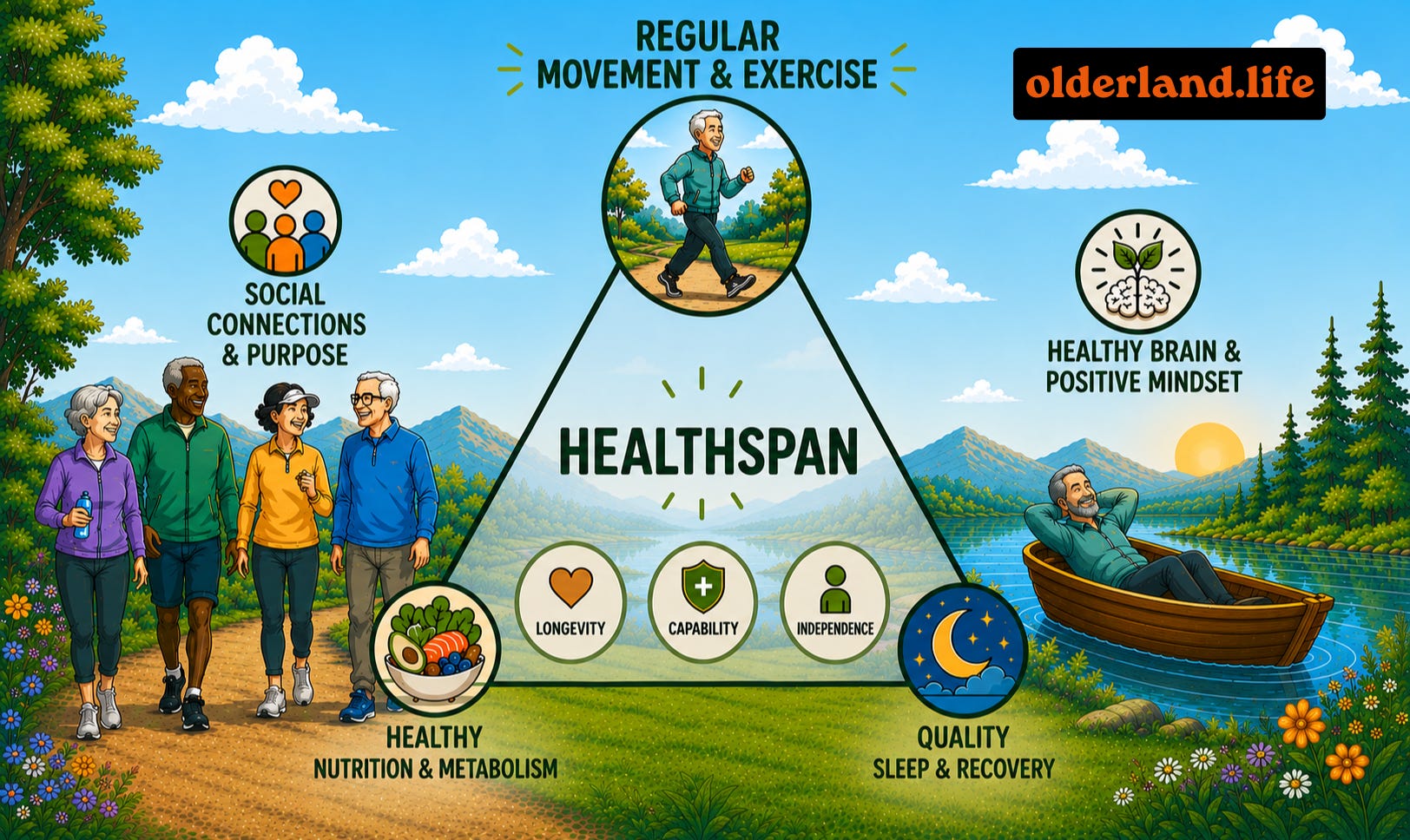
In the Iron Triangle, healthspan sits above three core outcomes. These are what most people actually want when they think about the future:
Longevity: Living longer matters, and most of us would quite like a few extra years. But longevity on its own is an empty metric. Very few people would choose to reach 95 if those extra years only came with a hospital bed. Longevity only becomes valuable when it travels alongside capability.
Capability: Capability is your functional currency, not your bench press 1 rep max. It’s the ability to walk up hills, carry shopping, travel, play sports, and get up from the floor. It’s being able to lift your grandchildren or open a stubborn jar without having to wait for a passing teenager. Capability is what turns years of life into years of living.
Independence: Independence is the outcome people care about most. It means remaining the author of your own life—making your own decisions, living where you choose, looking after yourself, and maintaining your dignity. Longevity simply creates the opportunity; capability helps preserve it.
The three non-negotiables
To achieve these outcomes, we need to commit to the three non-negotiable foundations of healthspan that link everything together.
Regular movement & exercise
At the apex sits physical activity. Not because it’s the only thing that matters, but because it influences almost everything else. Regular movement systematically improves cardiovascular health, muscle strength, balance, bone density, insulin sensitivity, sleep quality, and mood.
More importantly, it preserves the physical abilities that underpin independence—standing from a chair, climbing stairs, carrying groceries, and avoiding falls. These aren’t athletic achievements; they’re functional capabilities. Movement is the keystone habit because it anchors the entire system.
In future posts, I’m going to show you how to improve your functional capability without having to spend hours in a gym (unless you want to).
Healthy nutrition & metabolism
Food isn’t simply fuel; it’s a daily contribution to your health. Every meal influences blood sugar, inflammation, body composition, and metabolic health. Good nutrition supports healthy muscle mass, stable energy levels, and cognitive function.
It also works hand-in-hand with movement: protein helps maintain muscle, while exercise signals the body to keep it. Neither works as well in isolation. The goal here isn’t dietary perfection; it’s creating a body that still functions well now, and twenty years from now.
I aim to help you make good nutrition easy, convenient, and delicious.
Quality sleep & recovery
Sleep is often treated as a luxury—something that happens after you’ve finished doing important things. But sleep is where essential maintenance happens. It’s when memories are consolidated, tissues are repaired, and hormones are regulated.
Our modern ‘do more’ optimisation culture is the enemy of adequate recovery. Active recovery should be the final component of every sensible exercise programme.
I’ll show you how to prioritise high-quality sleep and make active recovery a natural part of your week.
The Iron Triangle neatly fits into this shorthand acronym SPAN:
Sleep, Physical Activity, and Nutrition.
The two pillars supporting the triangle
The framework places two elements outside the Iron Triangle. Not because they’re less important, but because they form the psychological scaffolding that supports everything else.
Social connections & purpose
We’re inherently social creatures (even those of us who occasionally dream of moving to a remote cottage with only a dog to chat to). Meaningful connections are directly associated with longer life, better mental health, and lower rates of cognitive decline.
Purpose matters just as much. People need a reason to get out of bed. That purpose doesn’t have to involve changing the world; it might be an allotment, grandchildren, volunteering, a hobby, or a weekly walking group. Purpose creates momentum, momentum drives action, and action protects healthspan.
I’ll provide powerful tools to help you find your ‘why’ and stay connected to the things that matter to you.
Healthy brain & positive mindset
A healthy brain is about far more than the absence of disease; it includes curiosity, resilience, and a willingness to remain engaged with life. Mindset heavily dictates behaviour.
People who see ageing as an inevitable, rapid slide downhill often start withdrawing from challenges surprisingly early. They move less, learn less, and socialise less. Their world gradually becomes smaller.
Conversely, those who remain curious continue investing in the habits that support healthspan—not because they have more discipline, but because they still see possibilities.
I’ll highlight practical ways to protect your brain structure and function, while maintaining a growth mindset to make the most of whatever comes your way.
Why everything must work together
This is the most critical message of the framework: healthspan isn’t built by optimising a single thing. It emerges from balance.
You can’t out-exercise a poor diet. You can’t be sleep-deprived all week and “catch up” with a Sunday lie-in. You can’t scroll Facebook to compensate for true social isolation.
There are plenty of “one-note” singers out there claiming that a specific workout method changes everything, or that one strict diet is the ultimate answer.
What you really need is to write your own song—and I’ll show you how.
What next?
The Iron Triangle isn’t a rigid programme; it’s a map and a compass. I’m going to regularly publish practical activities to help you build, use and keep your version of healthspan.
My goal isn’t to persuade you to turn your life upside down. After a heart attack and quadruple bypass, I’m following this plan in my own life, so I’m really not interested in the latest “silver bullet”.
I want to help you start to make small, sustainable changes that quietly shift the odds in your favour:
A ten-minute walk after lunch.
An extra serving of protein at breakfast.
A slightly better bedtime routine.
A phone call to an old friend.
These tiny choices don’t seem particularly remarkable on any given day. But they become remarkably powerful when multiplied across a lifetime. And we won’t stop there.
Ageing well is rarely about doing extraordinary things. It’s about doing the things that make us feel better this afternoon - and in ten years time.
And that’s what healthspan is really about.
Cheers 👋
Stuart
Medical Disclaimer: This article is for general information only and does not constitute medical advice. The needs of every reader are unique; please consult your GP or a qualified healthcare professional before making changes to your diet, exercise routine, or medication. Never ignore professional medical advice because of something you read online.