

We All Thought 150 Was the Ceiling. Turns Out It’s the Floor
A major new study suggests the biggest cardiovascular benefits may require far more activity than current guidelines recommend — but it's not all bad news.


We’ve heard the mantra for years now - 150 minutes of moderate physical activity a week. A brisk walk here. A bike ride there. Maybe some gardening if you’re particularly enthusiastic with the secateurs. Not too outlandish.
But a new study suggests that if your goal is properly protecting your heart as you age, the bar may be considerably higher than many of us realised.
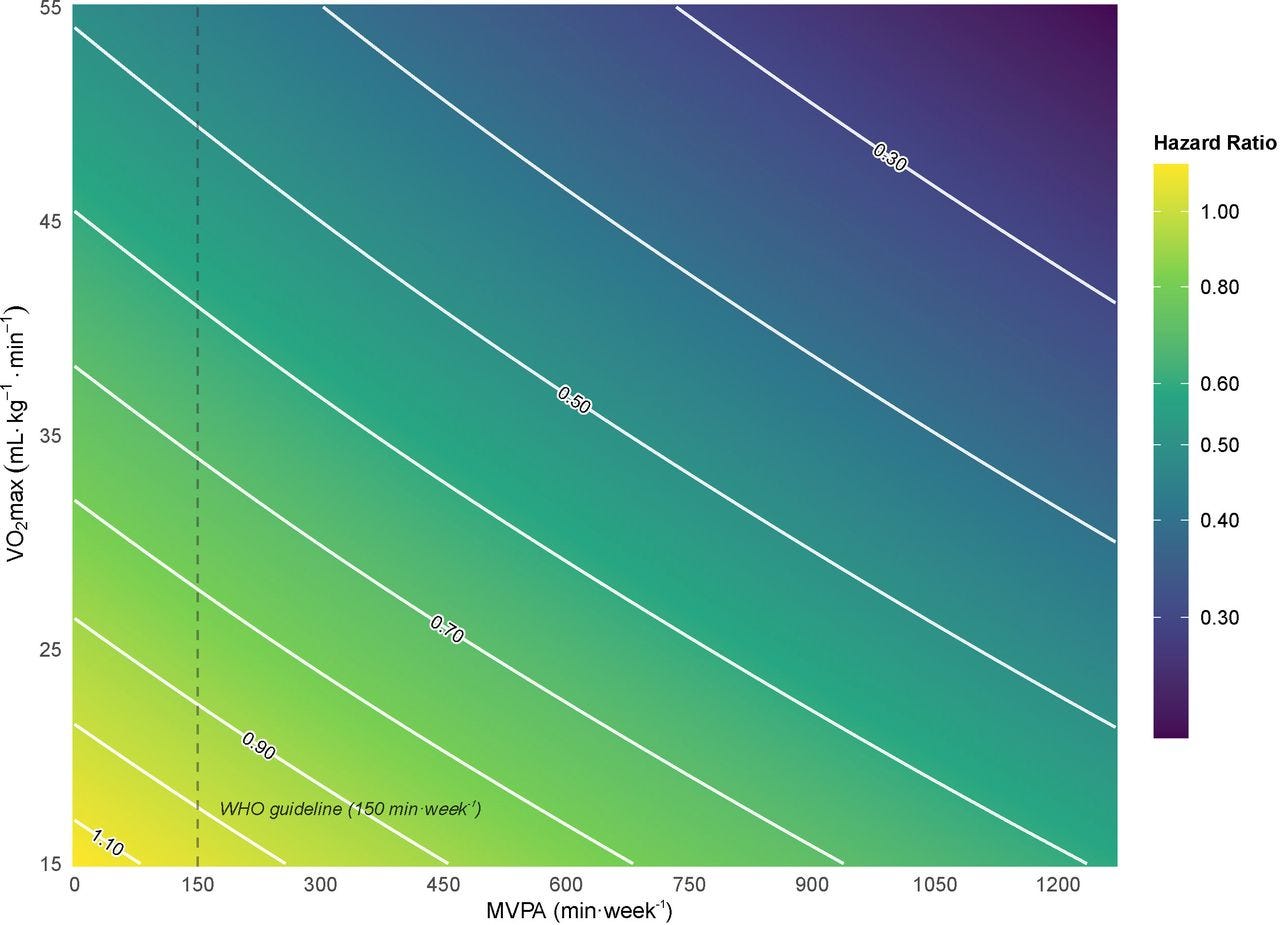
A study published in the British Journal of Sports Medicine looked at more than 17,000 adults from the UK Biobank study. They found that while the current guideline of 150 minutes per week of moderate-to-vigorous physical activity (MVPA) was linked to around an 8–9% lower cardiovascular risk, much larger benefits appeared at considerably higher levels of activity.
To achieve what the researchers classed as a ‘substantial reduction in risk’ — more than 30% lower cardiovascular risk — people needed somewhere between 560 and 610 minutes per week of moderate-to-vigorous physical activity.
That’s roughly 80 to 90 minutes a day.
Yep. An hour and a half.
Suddenly claiming bragging rights for hitting 150 minutes feels more like asking for a medal during the warm-up.
As with all observational studies, this doesn’t prove the exercise itself caused the entire reduction in risk, but the association was strong.

Before everyone hits the panic button
There’s an important nuance here.
This study doesn’t mean the current guidelines are pointless. Quite the opposite. The researchers themselves said the existing recommendation still provides a solid minimum level of cardiovascular protection.
And that matters because many of us already struggle to hit even that target.
According to Sport England and NHS England data, around one-third of adults in England still fail to achieve the recommended 150 minutes of activity each week. And although activity levels among older adults have improved in recent years, inactivity still becomes more common as we age.
So when researchers start talking about 600 minutes a week, it’s worth remembering how distant that feels for a large chunk of the population - as in “What’s the bloody point?” distant.
Fitness matters as much as movement
The really interesting part of the study wasn’t simply the amount of activity. It was the role of fitness itself.
The researchers looked at cardiorespiratory fitness — essentially how efficiently your heart, lungs and muscles work together during exercise. One of the best ways to estimate this is VO2 max.
That’s the maximum amount of oxygen your body can use during cardio exercise. In simple terms, it’s a measure of how good your endurance engine is.
And here’s the awkward bit.
People with lower fitness levels needed to do slightly more activity than fitter people to achieve the same cardiovascular benefits.
For example, to achieve a 20% lower cardiovascular risk:
People with high fitness needed around 340 minutes of moderate-to-vigorous activity per week
People with low fitness needed about 370 minutes
That may not sound dramatic, but the researchers described it as “the steeper challenge faced by deconditioned populations.”
Which is a polite academic way of saying: getting fit when you’re unfit is annoyingly hard, precisely when you’d quite like it to feel easier.
And there’s another catch
The study only looked at moderate-to-vigorous aerobic activity and cardiovascular outcomes.
It didn’t take into account:
strength training
muscle power training
balance work
mobility
flexibility
All of which matter enormously for healthspan.
Because if you were designing the ideal exercise programme for healthy ageing, you wouldn’t simply tell people to do more cardio until they collapse gently into the nearest hedge.
You’d also want:
resistance training to preserve muscle and bones
power training to maintain reaction speed and reduce falls risk
balance work to maintain independence
mobility to keep joints functioning properly
In other words, once you add the things we probably should be doing for proper healthspan — not just cardiovascular risk reduction — the total amount of recommended movement can start to look slightly terrifying for Mr and Mrs Average.
That’s one reason public-health messaging needs to tread carefully.
Telling an already sedentary 62-year-old office worker they now need 10 hours of cardio plus strength training plus mobility and balance work every week may inspire despair and scorn rather than action.
The real message
I suspect the practical lesson here isn’t that everyone suddenly needs to exercise for 90 minutes a day.
One hundred and fifty minutes now looks like the minimum effective dose rather than the target. Benefits appear to continue rising beyond that level.
The broader message seems fairly clear:
150 minutes a week is a valuable minimum — it’s the floor, not the ceiling
Some movement is always better than none
More movement is generally better still
Occasional higher intensity matters
Strength and muscle power matter too
Consistency beats occasional heroics
You absolutely don’t need to become a HYROX superstar any time soon. You just need to make movement a higher priority and design your life to make it a bit easier to do, and then build from there.
To achieve that you’ll need to:
Walk more with purpose
Lift and carry heavy things
Climb stairs
Occasionally get properly out of breath
Building this type of ‘functional’ fitness will make everyday life feel just a little easier than it did last week.
And the best way to start achieving that is still to join the 150 club.
Cheers 👋
Stuart
Medical Disclaimer: This article is for general information only and does not constitute medical advice. The needs of every reader are unique; please consult your GP or a qualified healthcare professional before making changes to your diet, exercise routine, or medication. Never ignore professional medical advice because of something you read online.