

Imagine a Fish Out of Water. That’s You
The Story of the Human Body by Daniel Lieberman, Professor of human evolutionary biology at Harvard, shows how we need to change our world to fit our hunter-gatherer bodies.

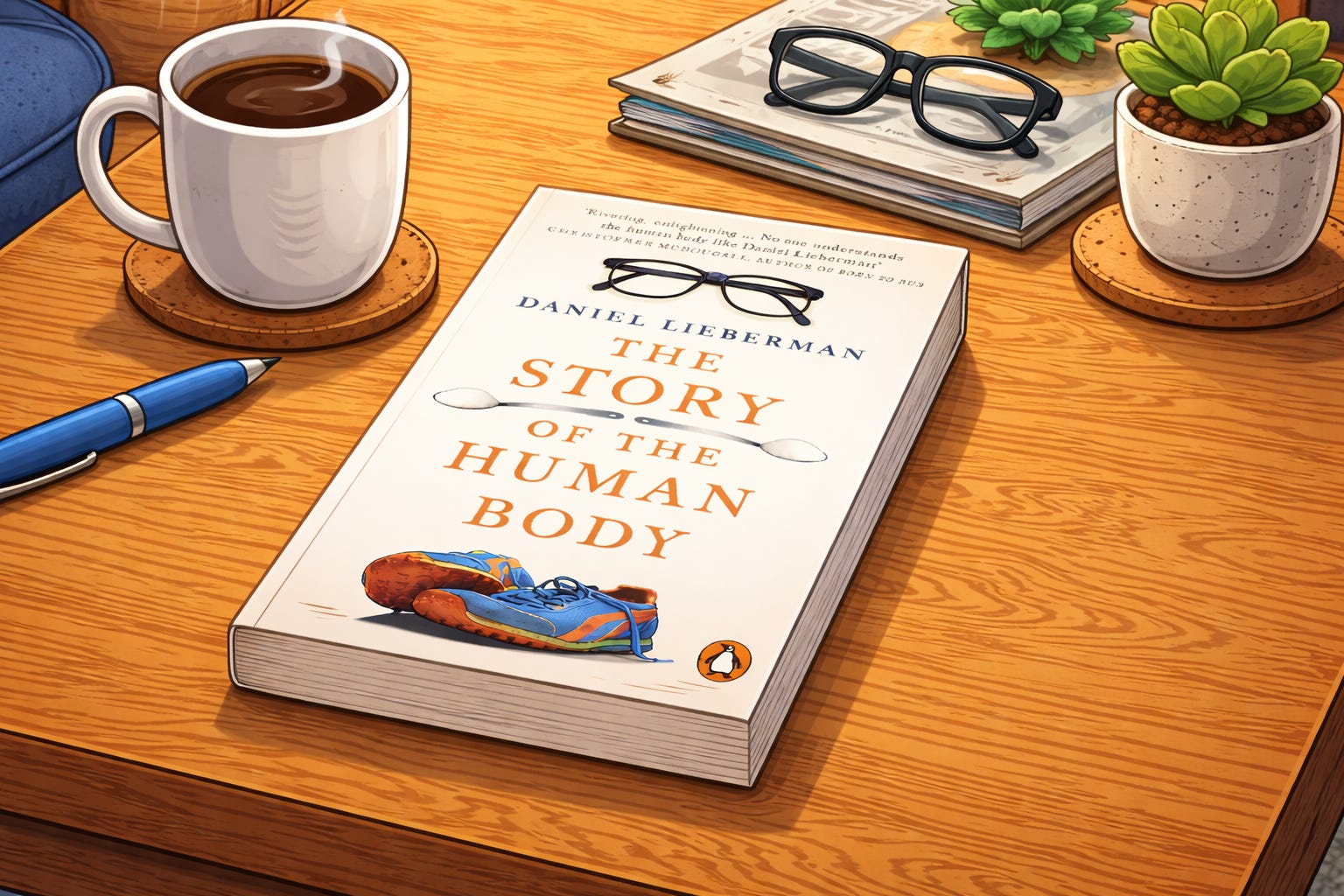
The book in a nutshell
Lieberman’s central idea is that the human body evolved for a very different world than the one we now live in.
For millions of years, we adapted to environments that involved constant movement, scarce food, and physical effort. Then, in a relatively tiny space of time—with agriculture, then industrialisation—we changed the rules completely.
Our bodies haven’t caught up.
The big idea
Your body is adapted for one environment, but you’re living in another.
That gap is where most modern health problems come from.
We evolved to move all day, now we sit
We evolved to work for food, now have constant access
We evolved to store scarce energy, now we have too much and over-store it
We evolved for scarcity, now we live in abundance
The result: obesity, type 2 diabetes, heart disease, back pain, and more.
None of these were common before farming and industrialisation.
We solved old problems and created new ones.
Lieberman doesn’t argue we should “go back” to caveman life.
He maintains modern life is objectively better in many ways:
Longer lifespan
Lower infant mortality
Better medical care
But…
We’ve engineered comfort and convenience so well that we’ve removed the very stresses our bodies need to stay healthy.
Key insights
1. Exercise isn’t optional
Your body expects movement as a baseline, not a bonus.
You don’t “get” health with exercise, you maintain it.
2. Comfort is the problem
We’ve designed effort out of life.
Lifts instead of stairs
Cars instead of walking
Chairs instead of squatting
Convenience feels good at the time, but your body pays for it later.
3. More isn’t always better
Agriculture and industry gave us more food—but not always better food.
Calories went up. Nutrient quality didn’t always follow.
4. Prevention beats treatment
Modern medicine is brilliant at fixing things once they go wrong.
It’s much less effective at stopping them going wrong in the first place.
5. Culture is outrunning biology
Biological evolution is slow.
Cultural evolution—how we live, eat, and move—is fast.
Right now, culture is racing ahead.
What to do with this information
You don’t need to live like a hunter-gatherer.
But you probably need to borrow a few of their habits.
Move more throughout the day
Don’t default to comfort
Build strength and resilience
Eat like food isn’t always guaranteed
Set up your environment so the healthy choice is the easy one
The one takeaway
We often think of “diseases of ageing” as inevitable.
But it’s what happens when a body built for one world is dropped into another.
Creating a better match between our ancient bodies and our modern environment pays off.
Who this is for
If you like understanding the why behind health, this is a strong read.
If you want a step-by-step plan, it isn’t.
But once you see the mismatch between how we live and how we evolved, a lot of modern health advice suddenly makes more sense.
My rating
★★★★☆
Medical Disclaimer: This article is for general information only and does not constitute medical advice. The needs of every reader are unique; please consult your GP or a qualified healthcare professional before making changes to your diet, exercise routine, or medication. Never ignore professional medical advice because of something you read online.