

Add This Quick Test of Heart Rate to Your Healthspan Toolbox
It’s something you barely notice most of the time. It quietly operates in the background while you wrestle with your shopping and wonder if you'll make it up the hill without a breather.


I’m talking about your heart. The fist-sized pump that never sleeps, never gives up, and is the only thing keeping you in the land of the living.
The downside to owning such a high-performance machine? You’re the head mechanic.
Hidden within the lub-dub of your heartbeat is one of the most vital indicators of long-term healthspan: your resting heart rate. It’s a quick and simple report card on your fitness, stress, and recovery.
And the best part? It doesn’t require a subscription, a doctor, or a trainer in lycra shouting encouragement.
You already have what you need to measure it.
What this test measures
Your Resting Heart Rate (RHR) is the baseline of your biology. It’s the number of times your heart beats per minute while you’re doing absolutely nothing, before your morning coffee.
Properly measured, RHR is the ultimate efficiency metric. It reflects how hard your cardiovascular system has to work just to keep the lights on.
For most of us, the “normal” bracket sits between 60 and 80 bpm. But the range of measurements is startling.
On one end, you have the elite athletes. Tennis legend Björn Borg reportedly ticked along at 35 bpm. Five-time Tour de France winner Miguel Induráin was even more efficient, with a resting pulse of 28 bpm—a heart so powerful it only needed to beat once every two seconds.
At the other end of the scale? The stressed, sleep-deprived mid-lifer. Fuelled by caffeine and fresh from a brain-scrambling call with broadband customer support, their heart is ‘resting’ at marathon pace, all while they sit in a chair.
However, don’t get hung up on the “perfect” number.
The real magic isn’t the number itself—it’s the trend.
Why it matters
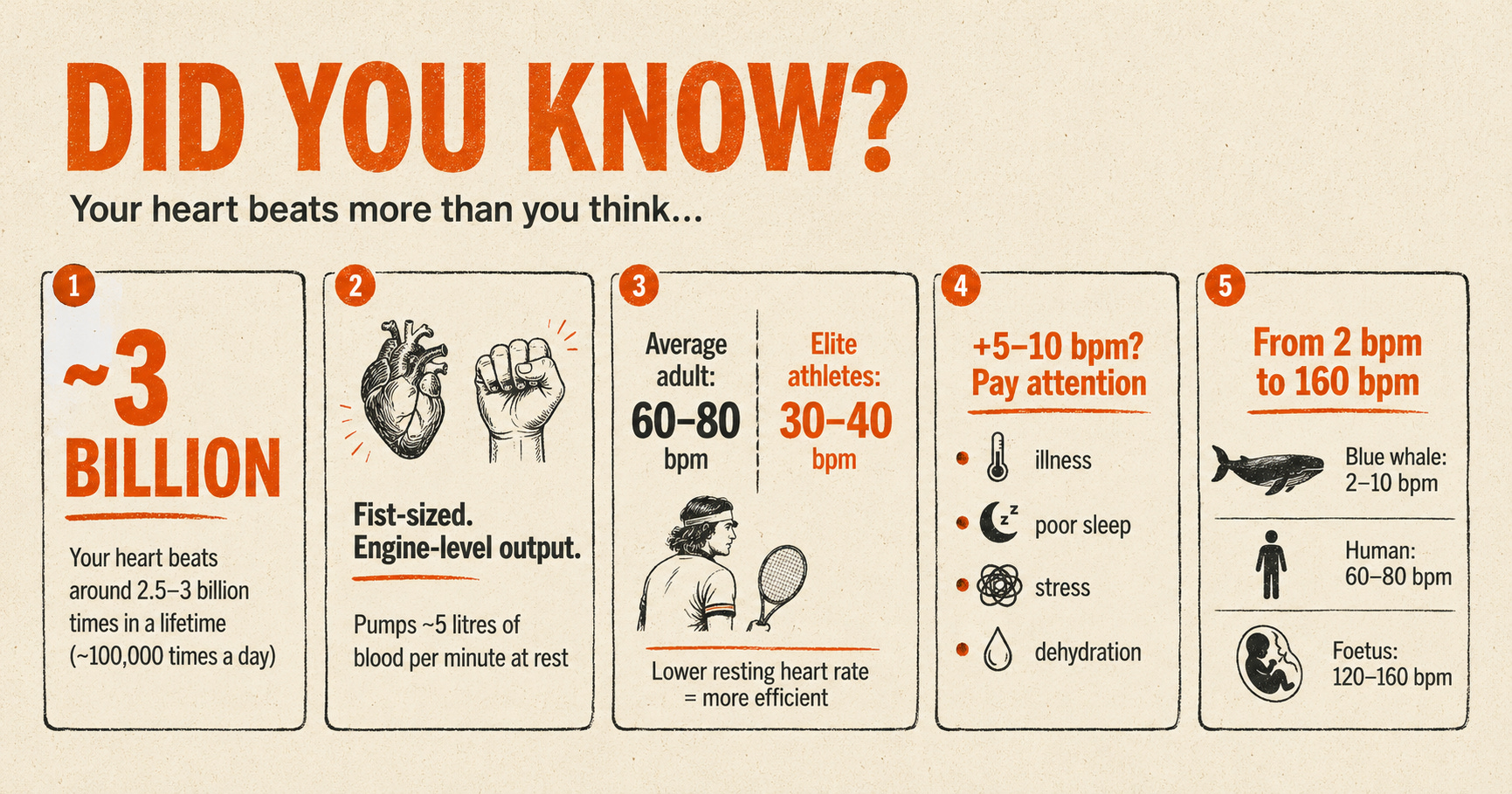
Your heart operates on a demanding schedule. On average, it beats:
100,000 times a day
35 million times a year
3 billion times in a lifetime
A lower resting heart rate usually signals a more efficient engine. When each beat moves more blood, your heart doesn’t have to beat as many times each minute.
Large-scale studies consistently link higher resting heart rates to increased risks of cardiovascular disease and earlier mortality. However, it isn’t always a straight line. Your pulse is a sensitive instrument influenced by a cocktail of variables: genetics, hydration, and whether or not you’re fighting off a bit of a bug.
Because of this, your RHR acts like a dashboard warning light. If your baseline suddenly jumps by 5–10 beats per minute and stays there for a few days, your body is sending a message. It’s the physiological version of a “Check Engine” light, usually signalling that:
You’re over-tired.
An illness is incubating.
You’re under-recovered or over-stressed.
We live in an era of high-tech wearables and ‘biohacker’ metrics, but most of them are just expensive ways of your body saying:
‘I need an early night.’
How to do the test
This is dead easy and very low-tech.
The best time to measure resting heart rate is:
first thing in the morning
before caffeine
before you start moving around, ideally


Method
Sit quietly for a few minutes.
Place two fingers on:
the inside of your wrist (radial pulse), or
the side of your neck (carotid pulse)
Count the beats for:
60 seconds, or
30 seconds × 2
Do this for several mornings and take the average.
That’s your baseline.
And baseline matters far more than obsessing over a single reading.
By all means use a smart watch, but there’s something more meaningful when your fingers are counting out the beats.
Making sense of your score
Once you have your beats per minute number, head on over to our calculator to find out how you compare with others of a similar age and sex. It’s not a competition but it’s handy to know where you stand.
Bear in mind that the comparisons are based on the assumption that a lower resting heart rate is ‘usually’ better. If the results says you are ‘below average’ that’s a good thing in this case.
What’s often more useful is asking:
“How are my measurements changing over time?”
How to ace your next test
You don’t lower resting heart rate by staring hopefully at your trainers.
You need to move more.
The usual boring advice turns out to work pretty well:
regular aerobic exercise
better quality sleep
stress reduction
less alcohol
stopping smoking
maintaining healthy body weight
Consistency is King and Queen here.
Go for steady activities such as brisk walking, cycling and swimming, where you can feel the effort but still keep up a conversation if required.
One of the great myths of ageing is that decline arrives like a piano falling from a window.
More often, it’s sneaks in through the back window.
You slowly lose fitness, capability, and resilience without really noticing — until climbing stairs starts to feel like a test.
Resting heart rate gives you a small window into that process.
Nothing fancy but useful all the same.
And in healthspan terms, useful beats complicated almost every time.
Give it a go today.
How did you get on? Let us know your scores in the comments.
Medical Disclaimer: This article is for general information only and does not constitute medical advice. The needs of every reader are unique; please consult your GP or a qualified healthcare professional before making changes to your diet, exercise routine, or medication. Never ignore professional medical advice because of something you read online.