

Try This Max VO₂ Self Assessment. From Your Sofa
Your watch estimates it, elite athletes obsess over it, and longevity influencers can't get enough of it—find out yours without setting foot in a testing lab.

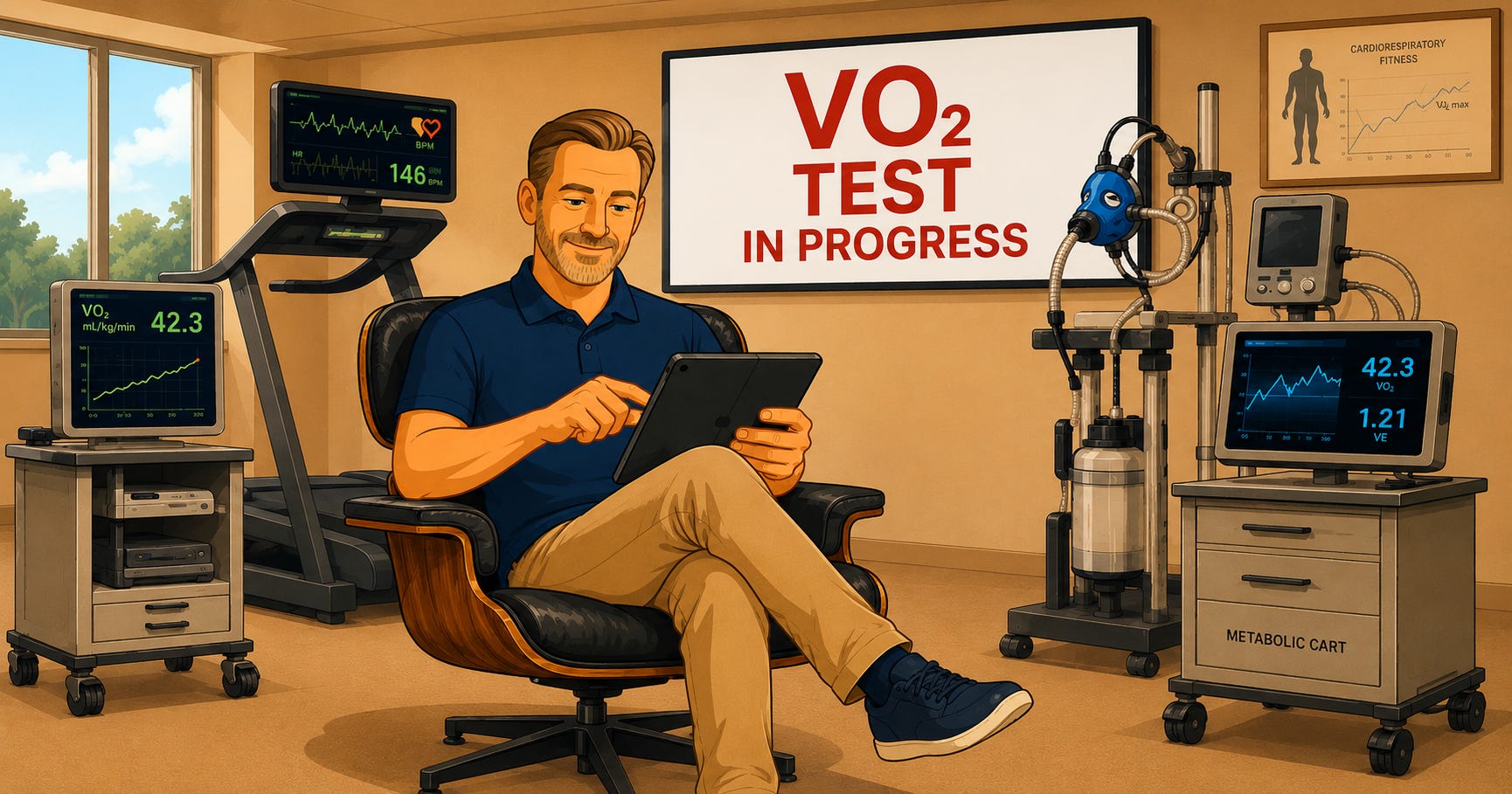
If you’ve spent any time wandering around the healthspan and longevity corners of the internet, you’ve probably come across people obsessing over their VO₂ max.
Elite athletes boast about it. Fitness watches estimate it. Exercise scientists treat it with reverence. Yet, most people have no idea what it actually means or why they should care.
The good news? You don’t need to spend hundreds of pounds in a sports science laboratory to get a useful reading. A simple calculator developed by researchers at the Norwegian University of Science and Technology (NTNU) can give you a reasonably accurate picture of where you stand.
It’s not perfect, but it’s a lot better than guessing.
What this test measures
In simple terms, VO₂ max is the maximum amount of oxygen your body can take in and use during vigorous exercise. Think of it as the size of your aerobic engine.
When you move, your muscles need oxygen to produce energy. The more oxygen your heart, lungs, blood vessels, and muscles can deliver, the greater your capacity for sustained physical activity.
Technically, it’s expressed as millilitres of oxygen per kilogram of body weight per minute (ml/kg/min). But the meaning is simple: a higher VO₂ max means better cardiorespiratory fitness.
Some of the highest scores ever measured
Males - Cyclist, Oskar Svendsen 97.5 ml/kg/min
Females - Distance Runner, Joan Benoit 78.6 ml/kg/min
A higher score doesn’t necessarily mean you’re a born athlete, but it indicates that your cardiovascular system is potentially capable of doing more work. Perhaps more importantly for those of us in Olderland, VO₂ max provides a crystal ball into how much physical reserve we may have available for the decades ahead.
Why it matters
Few metrics predict future health as consistently as cardiorespiratory fitness. Decades of research show that people with higher fitness levels have significantly lower risks of cardiovascular disease, type 2 diabetes, certain cancers, and premature death.
Your VO₂ max reflects the combined performance of your entire body:
Your heart’s ability to pump blood.
Your lungs’ ability to absorb oxygen.
Your blood’s ability to transport that oxygen.
Your muscles’ ability to actually use it.
When these systems work efficiently together, everyday life becomes a little easier. Climbing stairs feels less of an effort. Walking uphill ceases to be a trial. You recover faster from physical exertion.
This matters because VO₂ max naturally declines with age. Building and maintaining a decent VO₂ max is fundamental to our future capability.
How to do the test
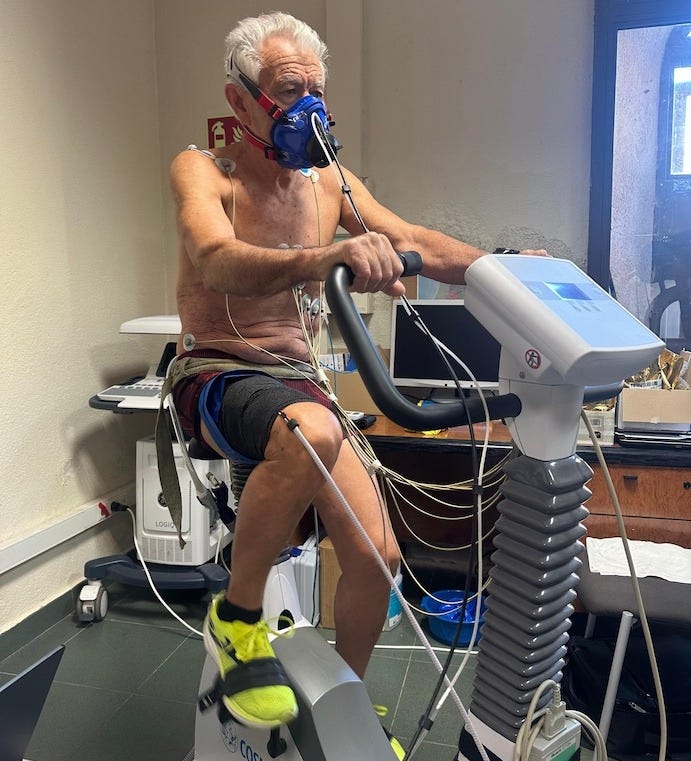
The gold-standard measurement involves a laboratory, specialist equipment, and a willingness to suffer. You run on a treadmill or cycle on an exercise bike while wearing a metabolic mask until you reach total exhaustion. It’s highly accurate, but it's also expensive, time-consuming, and inaccessible to most of us.
A more convenient starting point is the NTNU VO₂ Max Calculator, where you can enter your details into their calculator and get your VO₂ estimate without raising a sweat.
Researchers developed a model that estimates your VO₂ max by analysing easily accessible data:
Age and sex
Height and weight
Resting heart rate
Frequency and intensity of exercise
By comparing these factors against laboratory results from large population studies, they created a formula that produces a reasonably accurate estimate of VO₂.
Think of it as the fitness equivalent of using a bathroom scale instead of a medical-grade body composition scanner. It’s a practical, free way to gauge your fitness, track changes, and ensure you’re moving in the right direction. As a useful bonus, it also calculates your ‘Fitness Age’.
Making sense of your score
Once you get your score, the obvious question is: “Is that any good?”
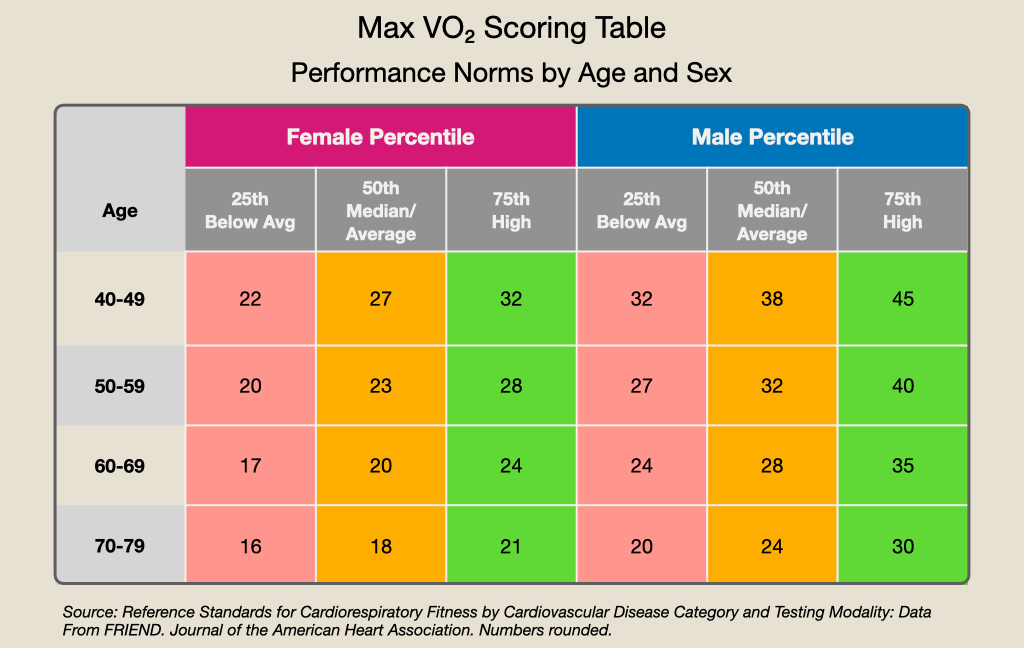
The answer depends entirely on your age and sex. The NTNU HUNT Fitness Study tracked thousands of healthy adults to establish how fitness benchmarks shift over time. You can find out more about the NTNU calculator by clicking here.
Bear in mind that some people are simply born with a naturally superior ability to transport oxygen. Because of this, VO₂ max is a measure of aerobic potential, not overall capability. A naturally gifted but sedentary person might outscore a highly active person who has less favorable genetics. Furthermore, someone with a modest VO₂ max can still enjoy robust health, strength, balance, and independence.
The number matters, but it’s only one piece of the healthspan puzzle. For most of us, the goal isn’t to become an elite athlete. A realistic target is to stay above average for your age and steadily work toward the 75th percentile.
Five ways to improve your score
The most encouraging thing about VO₂ max is that it responds beautifully to training. Even modest improvements can yield significant health benefits.
Move more often: Consistency always beats hero efforts. Regular walking, cycling, or swimming performed several times a week will improve your fitness far more effectively than occasional, gruelling workouts.
Increase intensity occasionally: Once you have a steady routine, introduce periods of harder effort. This could be brisk hill walking, cycling intervals, or the famous Norwegian 4x4 interval protocol. Spend just a few minutes a week forcing your cardiovascular system to work hard.
Build strength: Stronger muscles are more efficient at extracting and using oxygen. While resistance training won’t raise your VO₂ max as fast as cardio, it will support your efforts and aid your conditioning.
Reduce body weight: Because VO₂ max is calculated relative to your weight (ml/kg/min), carrying excess body fat mathematically lowers your score—even if your heart and lungs are in great shape. A quick cheat to improve your score is to lose some weight!
Remember rest and recovery: Adaptations happen between exercise sessions, not during them. Quality sleep, active rest, and proper nutrition are what allow your body to rebound and rebuild.
The bottom line
Your VO₂ max is one of the most useful metrics of healthspan available. It tells you exactly how well your heart, lungs, and muscles work together.
Treat your calculator result as a useful indicator rather than an absolute verdict. Use it to establish a baseline, track it over time, and aim to outpace the average for your age brackets.
The most important number isn’t actually your score today—it’s whether your score next year shows that you’re still managing your engine well.
Give it a go today.
Let us know your how you got on in the comments.
Medical Disclaimer: This article is for general information only and does not constitute medical advice. The needs of every reader are unique; please consult your GP or a qualified healthcare professional before making changes to your diet, exercise routine, or medication. Never ignore professional medical advice because of something you read online.