

If the Mind Moves the Body, Who Moves the Mind?
You don't need a personality transplant to become more active. You may only need to listen for the voice that keeps you on the sofa — and test what happens when you stop obeying it.

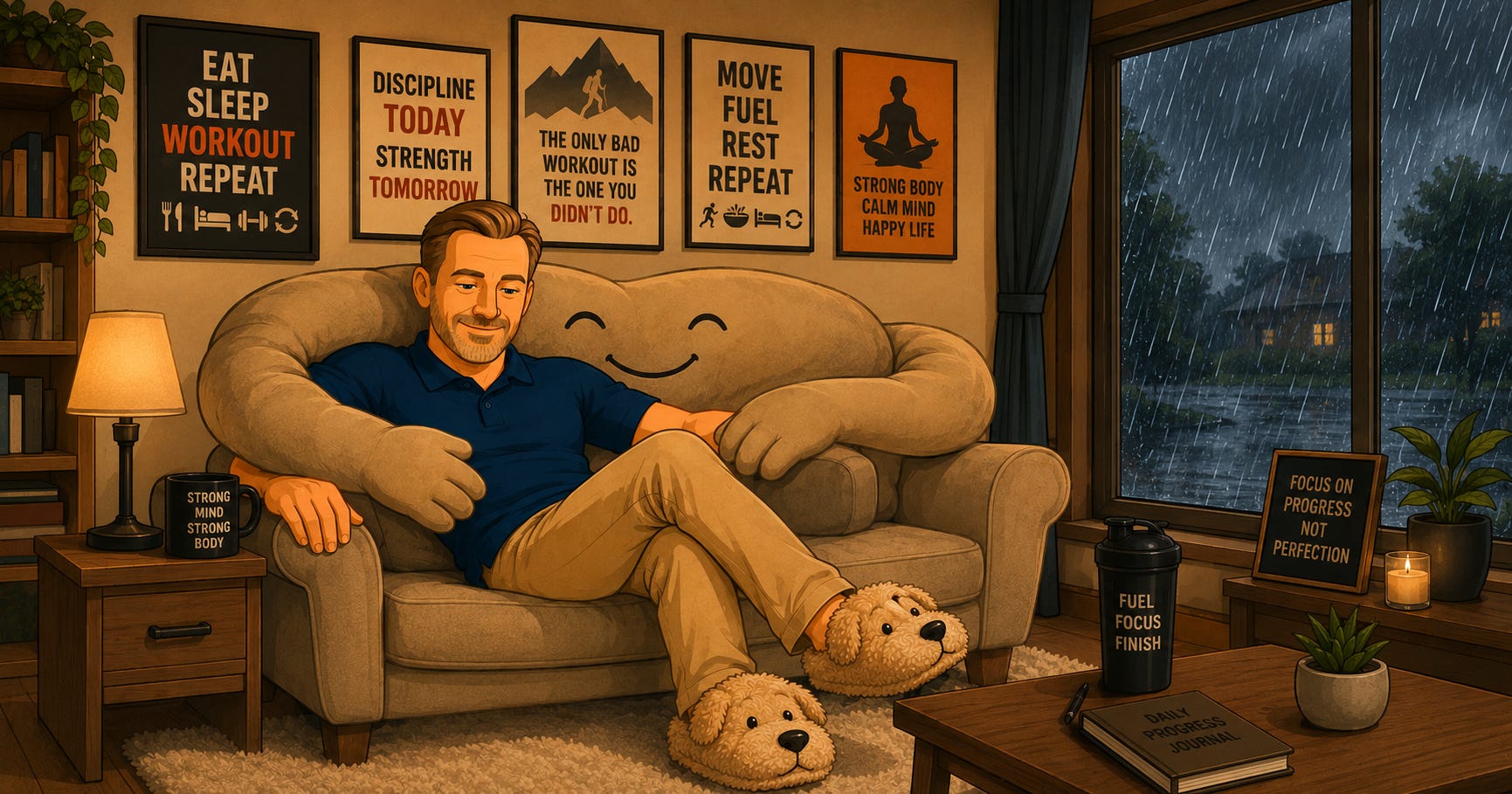
How beliefs, thoughts and behaviours shape what we actually do.
Most of us assume that changing our behaviour begins with a rational decision.
We decide to move more, eat better or finally do something about the fact that climbing the stairs now feels like attempting the north face of the Eiger.
Then, we invariably slide down to our default state of, nothing.
We usually blame this on a lack of motivation or a character flaw like ‘poor willpower.’ But Cognitive Behavioural Therapy (CBT) can offer a much more useful explanation: It’s about how our beliefs, thoughts, emotions and behaviours interact. Together, they create patterns that either push us forward or keep us firmly grafted to the sofa.
CBT is a useful tool for questioning the stories we tell ourselves, testing whether they’re actually true, and acting differently enough to collect new evidence.
Let’s use physical activity as our working example—though this framework applies just as well to expanding your social connections, changing your diet, or tackling any other healthspan-related change.
1. Beliefs: the hidden remote control
Beliefs are the deep-seated assumptions we hold about ourselves and the world. Because they’ve developed over years, they become so familiar that we stop recognising them as assumptions at all. We just treat them as facts.
Someone who struggles to exercise might believe:
‘I’m just not an active person.’
‘I’ve never been sporty.’
‘People like me don’t do that.’
‘I can’t do it properly, there’s no point.’
‘I’m too old to start now.’
These beliefs act like invisible algorithms controlling your life. They influence what you notice, what you choose to ignore and how you interpret reality.
For instance, if you believe you’re ‘bad at exercise,’ getting out of breath during a first jog is proof that running isn’t for you. A more objective interpretation? You’re simply a beginner doing something unfamiliar.
These beliefs lurk in the background, carefully editing the evidence to suit the preferred narrative.
2. Thoughts: the running commentary
Thoughts are the instant words, images and predictions that pop into your mind in response to a situation. CBT calls these Automatic Thoughts because they arrive uninvited.
Imagine you’ve planned to go for a walk after work. It begins to rain, and your brain instantly chimes in:
‘It’s too miserable outside.’
‘I’m too tired.’
‘Twenty minutes won’t make a difference anyway.’
‘I’ll start fresh on Monday.’
The rain is a fact. But the conclusion—that the walk is pointless—is just an interpretation.
Someone else in the exact same weather might think: “I don’t particularly fancy this, but I can manage ten minutes.”
Same circumstances. Completely different outcome.
3. Behaviour: what we actually do
Behaviour is the action (or inaction) that follows the thought.
You stay on the sofa. You feel immediate relief, paired with a promise to ‘do better next week.’
Unfortunately, the long-term result is disappointment and a reinforced belief that you lack discipline. The loop looks like this:
BELIEF: “I’m not the sort of person who exercises.”
└─► THOUGHT: “I’m too tired, and one short walk achieves nothing.”
└─► BEHAVIOUR: Stay on the sofa.
├─► IMMEDIATE RESULT: Relief.
└─► LONG-TERM RESULT: Less activity + more proof for the old belief.
Avoidance is tricky because it rewards us immediately—even when it makes our future lives harder.
4. Action comes before motivation
We tend to assume action requires motivation. We wait to feel energetic, confident and ‘ready.’
That gives motivation way too heavy a load to carry.
CBT suggests that action can come first. Action creates a slight shift in mood, builds momentum and provides tangible evidence that challenges an old belief. You don’t need to feel enthusiastic; you just need a version of the behaviour that’s small enough to execute without needing a cheerleader.
Put on your trainers. Step outside. Walk for ten minutes. You did it! Well done you.
Confidence arrives after the action, not before it.
Five practical tasks to break the cycle
If you want to shift a pattern you’re stuck in, run through these five exercises:
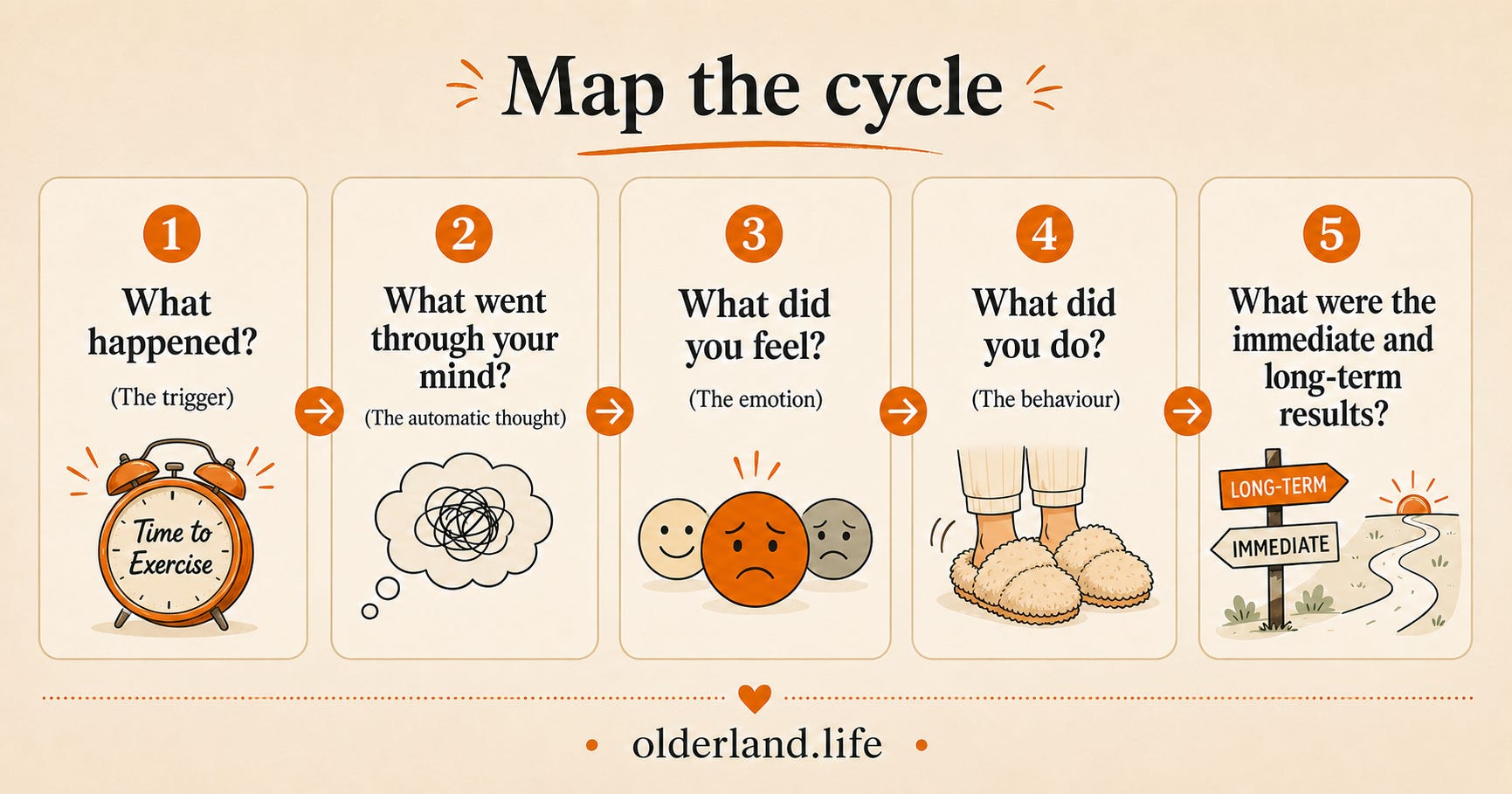
Task 1: become the observer
Think of a recent time you intended to do something (like exercise) but didn’t. Write down:
What happened? (The trigger)
What went through your mind? (The automatic thought)
What did you feel? (The emotion)
What did you do? (The behaviour)
What were the immediate and long-term results?
Writing this down separates objective facts from your mind’s interpretation.
Task 2: put the thought on trial
Take your main thought and examine it like a claim in court rather than an established fact.
If the thought is: ‘There’s no point unless I can do a full hour’s workout,’ ask yourself:
What evidence supports this?
What evidence refutes it?
What would I say to a friend saying this?
A balanced alternative: ‘A full exercise session is ideal, but ten minutes keeps the habit alive and counts for something.’
(Note: Your replacement thought must be believable. “I just love exercising in the pouring rain!” will rarely survive contact with a soggy Tuesday morning.)
Task 3: run a behavioural experiment
Some beliefs can’t be thought out—they must be tested.
If you’re starting Couch to 5K and think: ‘Everyone in the park will judge how slow and unfit I am,’ test it.
Rate your belief: How strongly do you believe this (0–100)?
Do the task: Complete session one.
Gather evidence: How many people actually looked at you? Did anyone react? Or were they mostly getting on with their own lives, apart from the odd sniff from a passing pooch?
The goal isn’t to pretend fear doesn’t exist; it’s to collect accurate evidence to update your brain’s assumptions.
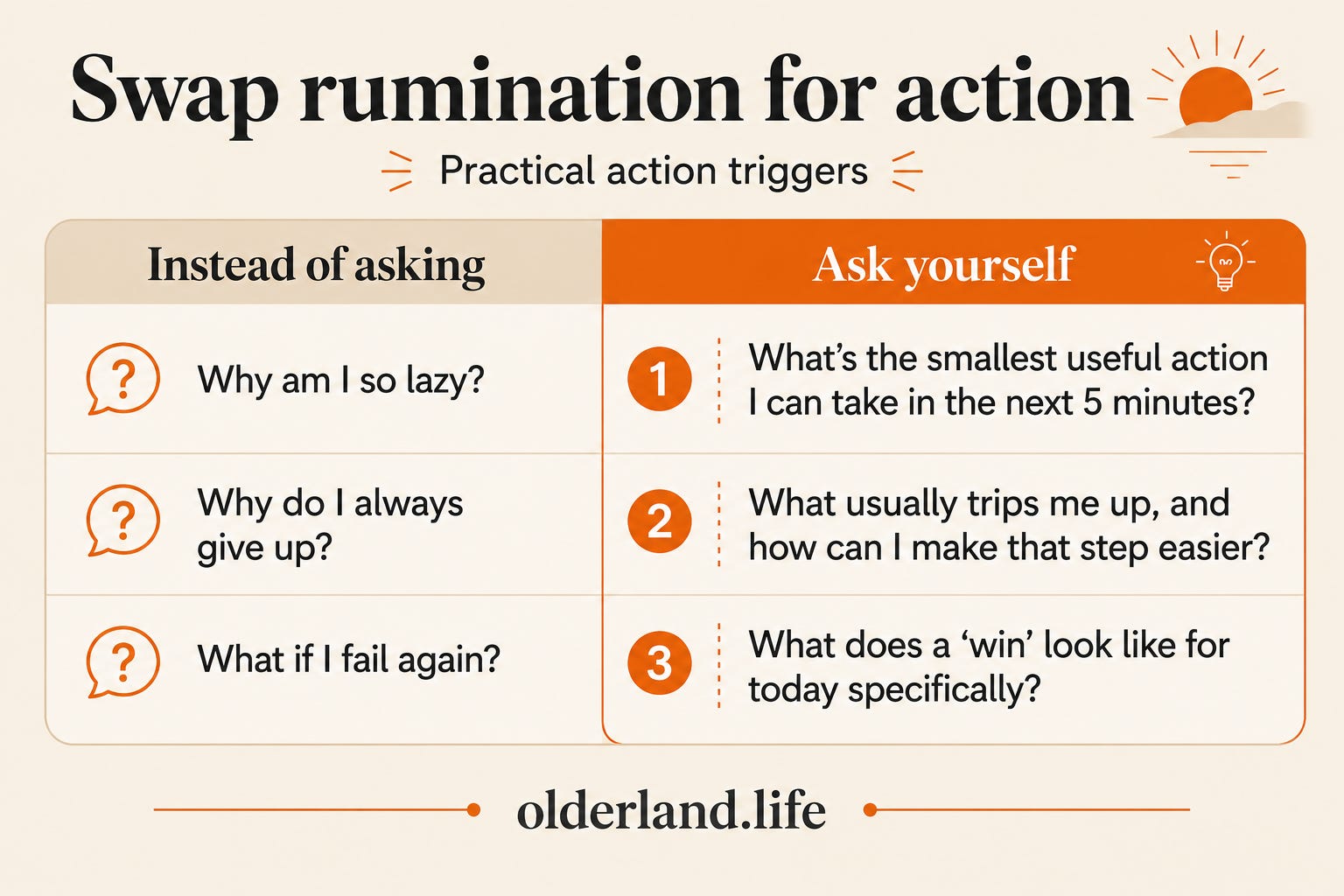
Task 4: replace the ‘why?’ of rumination with ‘what now?’
Rumination is repetitive thinking that circles around a problem without moving towards a decision or action. The mental engine is running, but it isn’t going anywhere.
In relation to exercise, it might sound like:
Why have I let myself become so unfit?
Why can everyone else stick to a routine?
What if I start and fail again?
This can feel like problem-solving because the mind is busy. In reality, it often increases unpleasant feelings while making action less likely.
A useful question is:
Is this thinking producing new information or a practical next step?
Rumination leads to: ‘Why can I never stick to anything?’
Reflection might lead to: ‘Evenings rarely work, so I’ll try a workout in the morning.’
One produces an experiment. The other produces more rumination.
Task 5: shrink the task (then shrink it some more)
When a behaviour feels overwhelming, reduce the scale until resistance disappears. Replace:
an hour-long workout with 10 minutes.
‘getting fit’ with walking around the block once.
completing a 12-week programme with just doing today’s session.
Small actions seem insignificant, but they disrupt the habit of avoidance. They begin to build a new identity: someone who moves, even when conditions aren’t perfect.
You don’t have to win the argument
Beliefs rarely change because we wrote an inspiring quote in a notebook. They change when repeated real-world experiences make the old narrative impossible to defend.
Someone who believes ‘I’m just not a runner’ gradually becomes someone who jogs three times a week—albeit slowly, and with occasional grumbles—simply because they accumulated the evidence.
The goal isn’t to eliminate every negative thought. It’s to realise that:
Thoughts aren’t instructions.
Beliefs aren’t facts.
Behaviour doesn’t need to wait for motivation.
Your mind will probably keep suggesting that it’s too late, too hard or not worth doing unless conditions are perfect.
You don’t have to win the argument with your brain.
You only need to jump off the sofa and start moving.
Over to You: Is there an automatic thought that consistently gets between you and something you want to do? Drop a comment below—or try Task 1 this week and let me know what you observe.
Cheers 👋
Stuart
Medical Disclaimer: This article is for general information only and does not constitute medical advice. The needs of every reader are unique; please consult your GP or a qualified healthcare professional before making changes to your diet, exercise routine, or medication. Never ignore professional medical advice because of something you read online.