

Cardiac Diary Part 8: Me and Statins. It's Complicated
Trying to get 'back to normal' is proving to be far from plain sailing. And just when I thought I'd nailed it along comes another dilemma. Should I stick or twist?


There’s an old saying, borrowed from the poker world, that goes something like this: if you look around the room and can’t see the idiot, it’s probably you.
In the case of statins, cholesterol and my heart health in general, that saying turned out to be uncomfortably accurate. But I’m getting ahead of myself. This part of the story really starts about eighteen months before my heart attack, when I decided, with the confidence of a man who should have known better, to turn myself into a health project.
After two lockdowns, I was bored, restless and slightly feral. Perfect conditions, in other words, for me to start a new ‘project’, which always brings an eye roll from Mrs D and the faint possibility of stormy weather ahead.
This time, the project was little old me. I was going to investigate all the recent health trends, try them out and emerge, presumably, as some sort of late-middle-aged wellness panther. Zone 2 training, 4×4 intervals, keto, intermittent fasting, high-fat, low-carb — I was going to do the lot.
The start was less than auspicious. While trying some intense sport-specific intervals with an agility ladder, I felt a sharp pain in my groin. It turns out sprinting sideways and being over 60 don’t always play well together. Who would have thought?
All snakes, no ladders
After a visit to the doctor, followed by a £400 emergency ultrasound, I was given the not-very-good news: a bilateral inguinal hernia. One on each side, because apparently one hernia would have lacked ambition.
The only real solution was surgery. ‘Project Me’ was already on life support, looking less like a physical transformation and more like a cautionary tale.
And then another complication. There were no hernia operations to be had, NHS or private. Surgeons were, quite rightly, working through the backlog created by lockdown, and my troublesome groin wasn’t top of the national priority list. It was going to be a long wait.
In the meantime, I could walk for about ten minutes before the pain kicked in, and I couldn’t do anything that raised intra-abdominal pressure, so weight training was out. All I could really do was potter about, spend too long online, and focus on my diet experiments.
You can probably see where this is going.
My activity levels fell off a cliff. At the same time, I was eating more and more as I tried different versions of ‘healthy’ eating. By the time I finally had my hernia operation in March 2022, I was around 10kg — or 22lb — heavier than normal.
The operation went well, but recovery still required patience, which has never been my specialist subject. After three months, I was back to regular exercise and beginning to say goodbye to some of the pre-injury flab. Then, one morning, while brushing my teeth, I noticed something in the mirror.
Here we go again
There were raised yellow bumps near the eyelids of both eyes.
A quick consultation with Dr Google identified the likely suspect as xanthelasma — yellowish cholesterol deposits that can appear around the eyes and are often associated with raised cholesterol. Not exactly the sort of facial accessory I had been hoping for.
Armed with a full lipid profile, I sat with my GP, who patiently explained that my cholesterol levels were sky-high and asked whether I would like a statin prescription.
I politely declined.
I explained that I had only recently got active again after the hernia operation, that my diet had been all over the place, and that I had been experimenting with a high-fat diet. In my head, this was a perfectly reasonable explanation. In hindsight, it was the sound of a man standing in a room, looking around, and failing to spot the idiot.
The rest, as they say, is history.
Pill life
Fast forward to the time after my bypass and recovery, I was given a prescription for medication I would probably be taking for the rest of my life. For someone who had been on no regular medication until that point, this was a sobering prospect.
The new daily routine looked like this:
Aspirin 75 mg — an antiplatelet medicine, often described as a blood thinner, which helps make the blood less sticky and reduces the risk of unwanted clots.
Atorvastatin 80 mg — a high-dose statin used to lower ‘bad’ LDL cholesterol and reduce the risk of future heart and blood vessel problems.
Ezetimibe 10 mg — a cholesterol-lowering medicine that reduces how much cholesterol is absorbed from the gut, mainly helping to lower LDL cholesterol.
In the grand scheme of things, it felt like a small price to pay to protect my expensive new plumbing.
The best advice I received about recovery came from a cardiologist I met on holiday. He told me not to believe the glossy version of recovery in the NHS brochures. Some things improve slowly, some things never quite go back to how they were, and recovery is rarely a neat upward line.
‘You had an open chest for six hours,’ he said, ‘with most of your insides rearranged. People need to be realistic about what to expect.’
We were playing padel at the time, so it may also have been a subtle distraction tactic on his part.
No straight lines in this recovery
Around eight months after the operation, I started to notice pains in my legs. Sitting still during a four-hour flight was agony, and the discomfort refused to go away. When I started playing tennis again, I would wake the next morning feeling as though both Achilles tendons had snapped. I could barely walk.
After speaking with my long-suffering GP, statin-related muscle symptoms became one possible explanation. This left me with a dilemma: stay on the medication and put up with the pain, or come off statins and risk watching my cholesterol climb again.
To be clear, this is not an argument for anyone to stop taking statins. They can be life-saving drugs for many people, especially after a heart attack, and any change needs to be made with a doctor. But in my case, the side effects were becoming hard to ignore.
Thankfully, I was thrown a lifeline.
Goodbye statins, hello inclisiran
Another visit to the doctor resulted in the words ‘statin intolerant’ being added to my record. I was fortunate to be referred to Harefield Hospital, a world-class centre for all things cardiac, where I was introduced to Inclisiran – a relatively new treatment that sounded almost too good to be true.
An injection, followed by another after three months, then one every six months after that, with the potential to halve my LDL cholesterol. All without the leg pains.
What’s not to like? I was in.
Inclisiran doesn’t remove cholesterol directly. Instead, it limits production of a protein called PCSK9. With less PCSK9 around, the liver can remove more ‘bad’ LDL cholesterol from the bloodstream. In simple terms, it helps the body’s natural cholesterol-clearing system work more effectively.
Clinical trials have shown that Inclisiran can reduce LDL cholesterol by around 50%, and in my case that’s pretty much what happened.
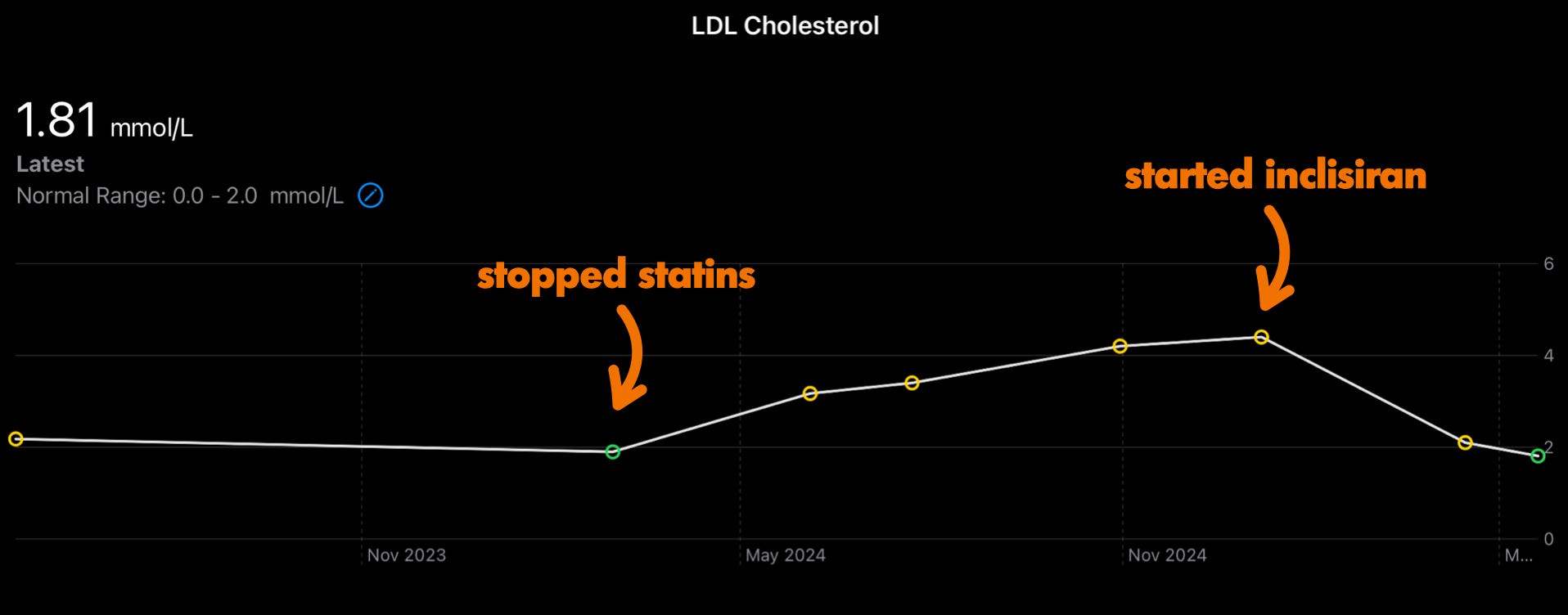
So far, I’m five injections in, and I couldn’t be happier with the outcome. My LDL cholesterol has been halved, and the awful leg pains have gone. The NHS list price is just under £2,000 per dose, so once again I find myself extending a heartfelt thank you to the NHS for making this possible.
I still need to keep up my end of the deal: regular exercise, sensible food, and fewer experiments that begin with ‘I read something interesting online’ and end with a consultant raising an eyebrow.
But if someone had offered me this deal before my heart attack — a twice-yearly injection, lower LDL, no crippling leg pain, and a second chance to take the whole thing seriously — I would have taken it gladly.
The idiot in the room may have been slow to learn. But at least he learned.
But then I read an interesting study online about GLP-1 injections and heart health...
This is Part 8 of my Cardiac Diary. Until next time…
Medical Disclaimer: This article is for general information only and does not constitute medical advice. The needs of every reader are unique; please consult your GP or a qualified healthcare professional before making changes to your diet, exercise routine, or medication. Never ignore professional medical advice because of something you read online.