

Cardiac Diary Part 7: Out in the Wild
I thought surviving the heart attack was the hard part. It turned out the next challenge was learning how to trust my heart again.


When my cardiac surgeon finally released me ‘into the wild’, I felt a little like one of those lions being reintroduced into the Serengeti. Still in the crate, the door now open, wondering what’s next.
The first thing I needed to negotiate was cardiac rehabilitation.
Since being officially discharged from hospital at the end of November, I’d been following my own rehabilitation programme with military discipline. Every day I walked a little further until I was regularly covering close to an hour a day.
There were still limits. Anything involving pressure through my chest was off the menu and anything overhead was strongly discouraged while my sternum knitted itself back together. Weight training, one of my favourite activities, would have to wait.
The assessment
The first step was a visit to the nurse for a cardiac rehab assessment.
There were the usual checks: height, weight, blood pressure and a long list of questions. Everything seemed reassuringly normal.
And then came the ‘step’ test.
This consisted of stepping up and down onto a platform to the beat of a metronome, while the team monitored my heart rate. The result would become my baseline score, ready for comparison at the end of the programme.
Once I’d passed that little audition, it was time to book my place on the eight-week course.
I was looking forward to attending in person. After weeks spent largely at home, the chance to meet and chat with people going through something similar had a strong appeal.
One of the NHS’s best kept secrets
Cardiac rehabilitation is one of the unsung heroes of cardiac medicine.
The 2025 National Audit of Cardiac Rehabilitation (NACR) highlights a long list of benefits. Patients who attend rehabilitation tend to have:
lower rates of cardiovascular mortality
fewer hospital readmissions
better fitness and improved quality of life
They also seem to do a better job of managing risk factors such as blood pressure, cholesterol, weight and smoking.
Given those benefits, you’d expect every patient to be breaking down the door.
Unfortunately, that’s not what happens.
The NHS Long Term Plan set a target that 85% of eligible cardiac patients should participate in rehabilitation by 2028.
Current uptake sits at a disappointing 50%.
Interestingly, uptake is highest among bypass patients, which probably isn’t surprising. After someone has literally opened your chest and rerouted your plumbing, you’re generally more inclined to follow instructions. I know I was.
Cardio school starts
The sessions themselves were surprisingly gentle, but I did see others found it more challenging, depending on exercise histories.
Each class started with a warm-up and stretching before moving into a circuit of simple exercises. At the end there was relaxation and guided breathing. We were all fitted with heart-rate monitors and given personalised heart-rate targets, with three nurses supervising everything.
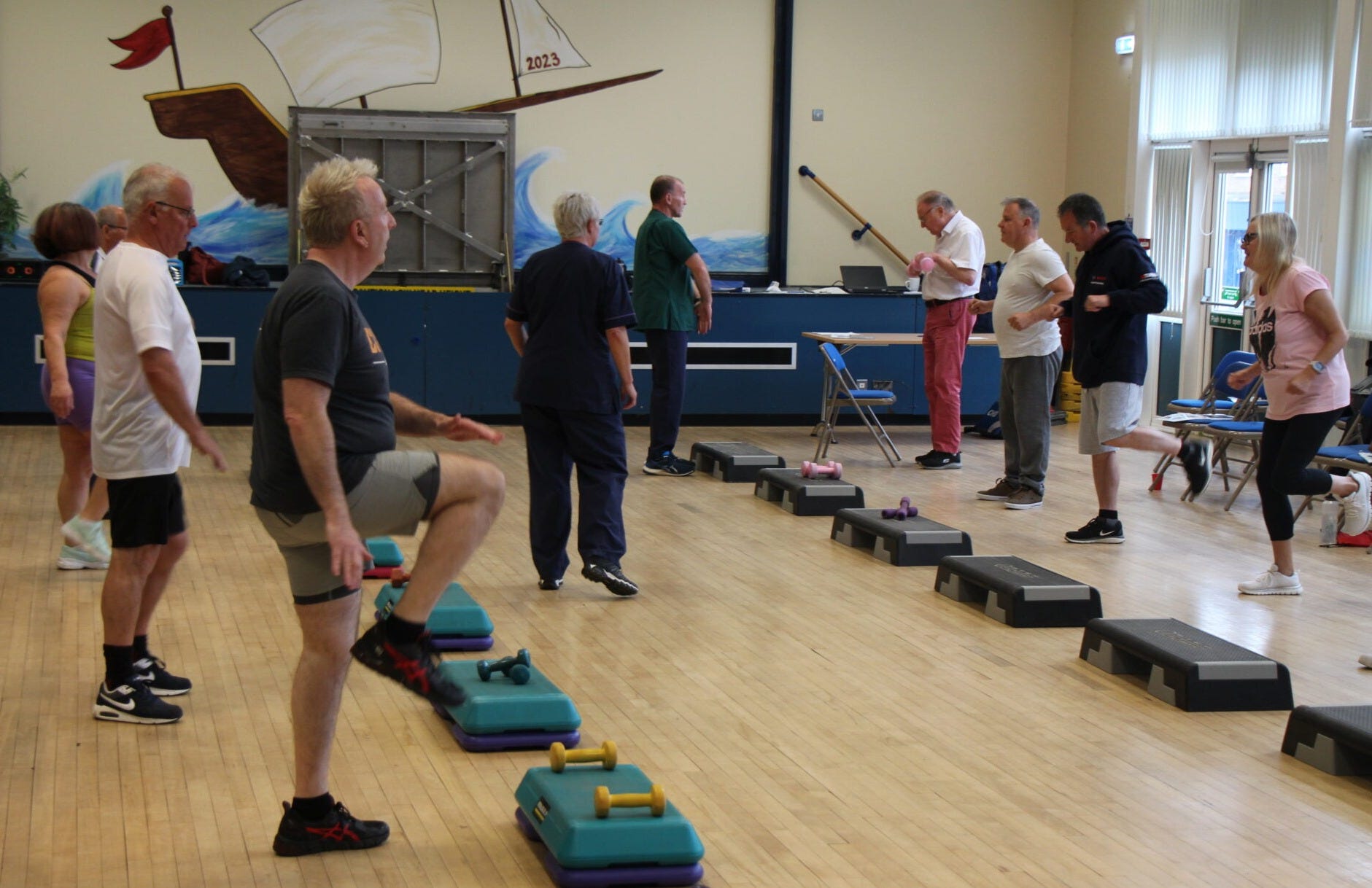
What struck me most wasn’t the exercise.
It was the people.
Every variety of cardiac misfortune seemed represented. Heart attacks, bypass surgery, stents, heart failure, valve replacements. The whole spectrum was there.
You quickly realise that heart disease doesn’t discriminate.
There was also a fascinating range of attitudes.
Some participants looked genuinely frightened every time their heart-rate monitor beeped. Others approached the sessions with the enthusiasm of naughty schoolchildren seeing what they could get away with.
Many of the men, particularly those from manual trades and physically demanding jobs, seemed to be wrestling with a new identity. They’d spent decades thinking of themselves as strong and capable. Suddenly, here they were, wearing a heart-rate monitor while being told not to overdo it on the step-ups.
I started making mental bets on who would complete the programme and who wouldn’t.
The national figures suggest the odds aren’t great.
The drop-off problem
Imagine 100 people leaving hospital after a heart attack or bypass operation:
100 are eligible for cardiac rehabilitation
Around 75 are referred
Around 55 attend the initial assessment
Around 50 actually start the programme
Only 35-40 complete the programme
In other words:
Around half never start
Another 10-15% start but don’t finish
Only around a third complete the full programme
One of the strongest predictors of completion is simply attending the first assessment.
Sometimes the hardest part is just making a start.
Lessons learned
At the end of the eight weeks I returned for reassessment.
My numbers had improved nicely, although I’d already been doing plenty of training outside the programme. My chest was healing, my leg wound was improving and my confidence was steadily returning.
Yet despite all that progress, the biggest lesson from the entire experience wasn’t about exercise.
It was about the difference between fitness and health.
Before my heart attack, I considered myself fit for my age. I exercised regularly, cycled, worked out with weights and generally did all the things health experts tell you to do.
What I failed to appreciate sufficiently was that fitness and health aren’t the same thing.
While I was busy accumulating miles and steps, my coronary arteries were quietly clogging up thanks in part to the genetics I’d inherited from my family and an over-enthusiastic liver that produced cholesterol with industrial efficiency.
I thought fitness would protect me completely.
I was wrong.
The good news is that being fit did help me in a different way.
My heart attack caused remarkably little permanent damage to the heart muscle itself. The surgeons repaired the plumbing, but the engine itself was largely intact, thanks to my large ‘functional reserve’ from regular aerobic exercise.
Perhaps even more importantly, fitness gave me a head start during recovery.
In week one I struggled to climb a full flight of stairs.
By week twelve I was managing basic interval training and resistance exercise.
The speed of recovery was remarkable.
The long road back
Bear in mind; everyone’s recovery journey is different.
Some people bounce back quickly. Others face setbacks and complications. Many struggle with the anxiety of exercising again after a cardiac event.
That’s entirely understandable.
When your heart has recently gone AWOL, deliberately raising your heart rate can feel counterintuitive.
But having been through the process myself, I can’t overstate the value of regular physical activity. The benefits far outweigh the risks, particularly when done gradually and under appropriate supervision.
By now I was officially out of the hospital system and back under the care of my GP.
A lifetime of medication now lay ahead. I also had to come to terms with the knowledge that high cholesterol wasn’t just something I had. It was something that ran through my family.
And physically, I still wasn’t out of the woods.
My body had one more surprise waiting for me
This is Part 7 of my Cardiac Diary. In the next post, I write about a life on medication, and the major complication nobody saw coming. Until next time…
Medical Disclaimer: This article is for general information only and does not constitute medical advice. The needs of every reader are unique; please consult your GP or a qualified healthcare professional before making changes to your diet, exercise routine, or medication. Never ignore professional medical advice because of something you read online.