

Cardiac Diary Part 2: From Civilian to Cardiac Patient
After my 'episode' was revealed as a heart attack in part one, it was my turn on the cardiac conveyor belt. Things quickly went from worse... to worser.

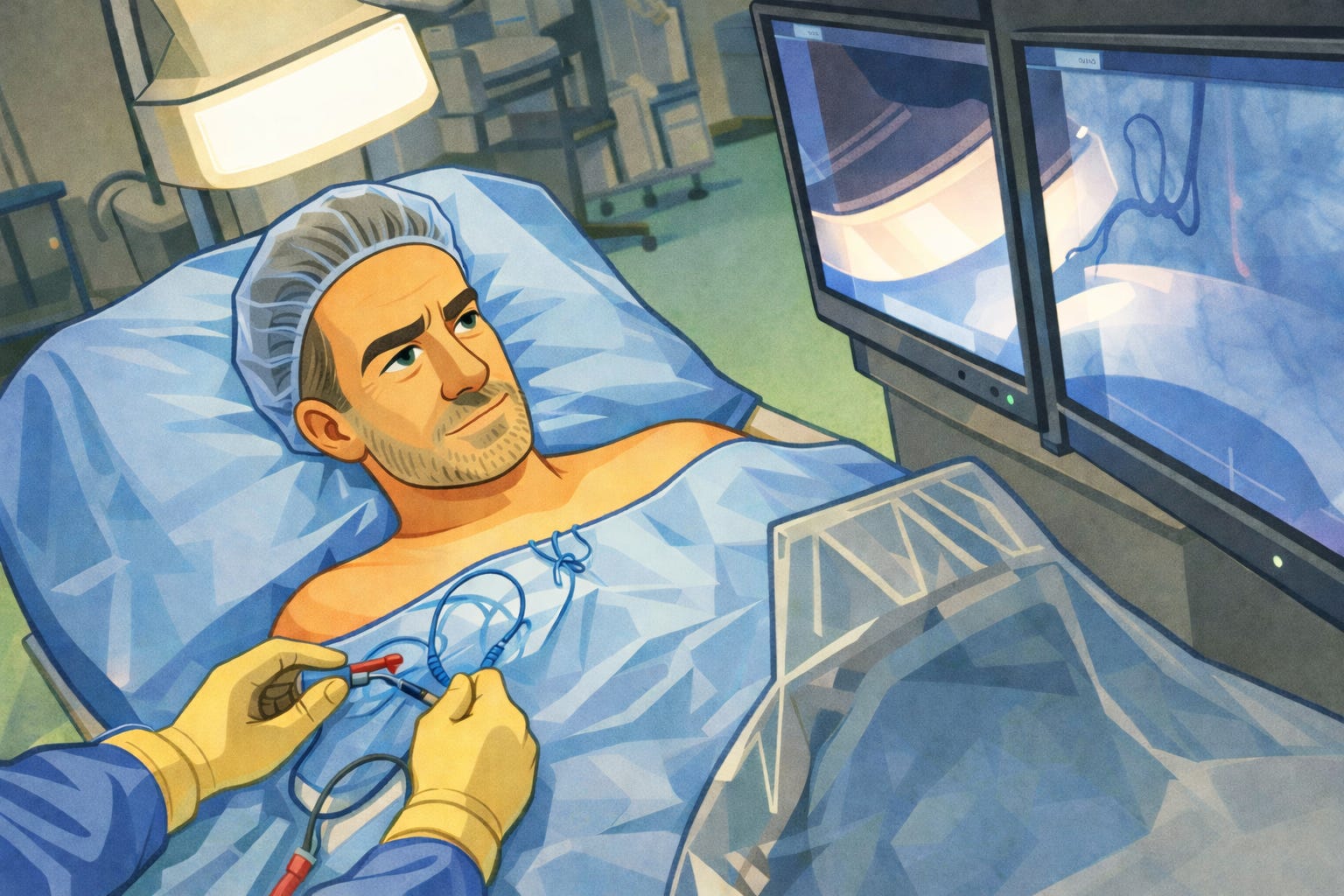
After arriving just before midnight in part one, it was now the early hours of the morning, and I was being shunted from one holding cubicle to another because, apparently, there wasn’t a bed available in a ward.
I had settled on the notion that I was in for a short stay — a bit of “observation”, a few checks, then home. Nobody had actually told me anything, so that’s how I chose to fill in the blanks.
As sunrise neared and shifts changed, someone finally told me a patient had been discharged, and that I now had a bed.
Good news.
Except that it was on a women’s ward.
Slightly less good news.
“It’s only temporary,” they reassured me.
The gears of the system started to move. I was given my first official patient transport experience: a wheelchair ride pushed by an orderly, with my belongings stacked in my lap and my heart monitor tagging along like a faithful pet.
I was wheeled into a curtained-off bed space and left to practice waiting again.
Let’s play cardiac bingo
After a short while, a doctor appeared and explained that I would be having a ‘series of tests’. So far, so mysterious.
Apparently, having already had a heart attack moves you into what might politely be called the ‘fast lane’.
My first item on the cardiac bingo card was a coronary angiogram.
I was wheeled into a room that looked like a cross between an operating theatre and a television control room.
Everyone was already there in scrubs, waiting for me.
I was ushered onto a narrow table beneath a large X-ray machine that hovered above like something from a science-fiction film.
To my left was a bank of monitors — screens full of images that clearly meant a lot to the professionals but very little to me.
This was to be my first ‘proper’ medical procedure related to my heart attack.
Like a metal worm
They made a small incision in my right wrist and inserted a thin wire into the artery.
I started to feel something — like a metal worm — making its way up the inside of my arm and into my chest.
It wasn’t painful. Just deeply odd.
Next, they injected a contrast dye.
Instantly, on the monitors beside me, my coronary arteries appeared in black, branching across the screen like the roots of a tree.
The idea, as I understood it, was straightforward enough.
If they found a small blockage, they could fix it there and then by inserting a stent — a tiny metal scaffold that props open the artery and lets blood flow properly again.
I was already mentally preparing for the conversation I’d have later at home.
“Yes, they put a stent in. Tiny thing, really. Very clever.”
Suddenly, the room went quiet.
The kind of quiet that shouldn’t be there.
Followed by some low muttering between a knot of people standing off to one side.
The general atmosphere shifted. It felt like the office party had ended early, and everyone was quietly stacking chairs.
For the first time since the whole process began, I stopped being an interested participant and became a concerned subject. For concerned, read worried.
One sentence changed everything
The consultant walked around to where I could see her.
She had the sort of face doctors wear when they’re about to say something disagreeable.
“Unfortunately, there are too many blockages,” she said.
“They’re too difficult to reach for stents.”
A small pause.
“You’re going to need a heart bypass. Probably a quadruple.”
And that was that.
No dramatic music. No slow fade.
Just a life-changing sentence.
And on that bombshell…
I was handed a printout of my results and wheeled back to my curtained bed space on the women’s ward.
And there I sat.
Stunned.
My head filled with a thousand thoughts.
To me, a heart bypass sat somewhere in the same category as heart transplants — serious, almost mythical procedures performed on other people.
Not people who had been playing tennis in the sunshine two weeks earlier.
Eventually, I pulled myself together and called Mrs D.
It was the first time I’d said the words out loud in relation to myself.
“I’m going to need a heart bypass.”
I had a small wobble on the phone.
And just like that.
My new life had started.
A second opinion from Dr Google
After the call, and pulling myself together, I did what everyone does nowadays when confronted with terrifying medical news.
I opened my phone and started searching Google.
Heart bypass survival rates.
Recovery times.
Life after bypass surgery.
To my surprise, the internet was full of people who had gone on to live very normal lives afterwards. Some were even running marathons.
That helped a bit.
I looked down at the small dressing on my wrist where they’d inserted the catheter.
Two hours earlier, that had been the main event.
Now it felt like a minor footnote.
Then it dawned on me.
This detour wasn’t a detour anymore.
I wasn’t a visitor to cardiac world.
I‘d now officially taken up residence.
And somewhere in my near future, a surgical team was planning to stop my heart, open my chest, and build me some new plumbing.
This is Part 2 of my Cardiac Diary. In the next post, I’ll dive into the reality of life on a cardiac ward, preparing for the biggest operation of my life.