

Small Wins Today. Bigger Wins Tomorrow
There's more to life than chasing longevity. Investing in your future health is important, but don't forget the version of you who wants to feel good today.


We’ve all been bombarded with the line: “Exercise reduces your risk of disease.”
Entirely true, of course. But if logic were enough to get us exercising, we’d all be in far better nick than we are.
The problem is that humans are remarkably bad at staying motivated by things that might happen in ten or twenty years. If you’re in your 50s, 60s, or beyond, “disease prevention” isn’t enough to get us moving.
Especially when it’s raining sideways, you’re knackered, and the sofa is ‘comfy HQ.’
As we get older, the “why” shifts. It’s less about vanity, or the abstract warnings of a GP, and starts being about something deeper:
More than sets and reps, it’s about capability, identity, and the quality of our here and now.
If you want to hit the healthspan jackpot—not just for today, but for the years ahead—we need to take a closer look at the real psychological drivers for an active life as we age.
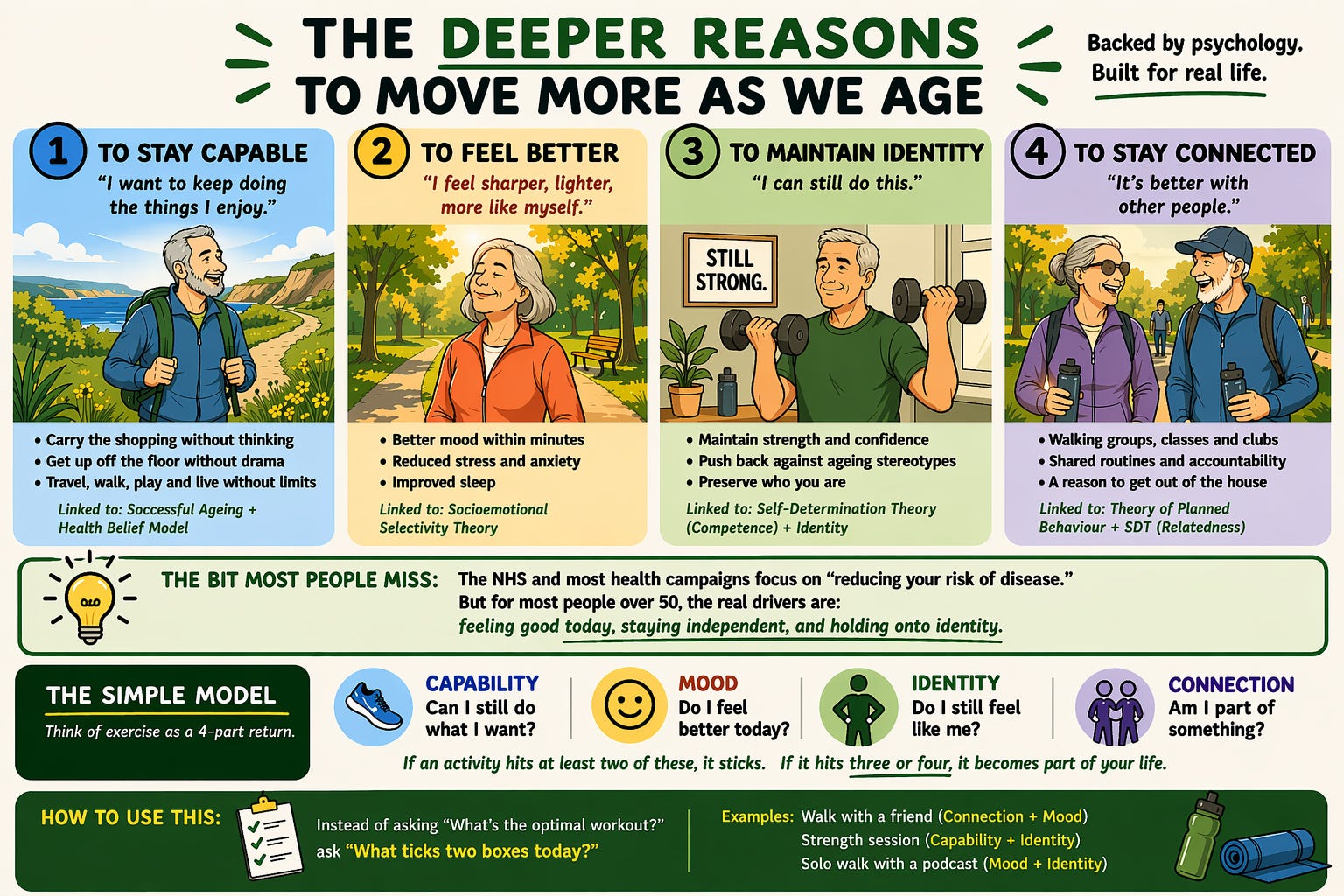
1. The Capability Factor
“I want to do what I want, when I want, as often as I want .”
This is fundamental. It’s not about “optimising your VO₂ max”—hardly anyone wakes up wanting to do that. It’s about:
Carrying the heavy bags from the car without a second thought.
Getting up off the floor without needing a furniture escort.
Travelling, exploring, and playing without wondering when your legs will down tools.
We don’t want to go backwards. We want to maintain our capability, with a little “in the bank” so that when life throws an inevitable emergency our way, we’ve got the physical reserves to handle it.
2. The Feel Good Factor
“I want to feel sharper, lighter, and more like myself.”
We’ve been sold a long-term pitch: “Exercise now to reduce your future health risk.” That’s a hard sell. Yes, healthy movement can provide those future benefits—but it also comes with instant dividends:
Your mood lifts.
The “brain fog” clears.
Sleep starts to look after itself.
“Exercise now to feel better today.” That’s an easier sell. When we frame movement as a way to improve our afternoon rather than our old age, it stops being a chore and starts being a valuable mood enhancer.
3. The Identity Factor
“I can still do this.”
Somewhere in your 50s, the narrative shifts. You’re told you’re no longer “improving”; you’re just “managing decline.”
Thanks, but no thanks.
Exercise is not only an act of resistance (literally). It’s the preservation of identity. It’s about still being the one who can open the lid on that stubborn jar or holding your own in a sport where your age is “supposed” to show.
There’s a profound psychological shift when you stop saying “I’m trying to get fitter” and start saying “I’m an active person.”
It’s no longer an appointment in the diary; it’s who you are. We act in accordance with our identity. If you see yourself as an “active person,” you’re more likely to do the things active people do.
4. The Connection Factor
“It’s better with other people.”
Left to our own devices, most of us would probably do less than we should. Other people change the chemistry. When you exchange a solo slog for a walk with others, it becomes:
Accountability: Someone is expecting you.
Belonging: You’re part of a loop, a club, or a class.
Connection: A reason to leave the house that has nothing to do with a heart rate monitor.
Once you find your tribe, stopping doesn’t feel like skipping a session—it feels like letting your mates down.
Putting it All Together
If you strip away the jargon, healthy movement gives you four benefits in the here and now:
Capability (Can I still do what I want?)
Mood (Does it make me feel better now?)
Identity (Does it help me still feel like “me”?)
Connection (Am I part of something?)
The Golden Rule: If what you’re doing ticks at least two of those boxes, it will likely stick. If it ticks three or four, it stops being “what you do” and becomes “who you are.”
Start Asking the Right Question
Most people get stuck asking: “What’s the best exercise programme for me?” It sounds sensible, but it’s the wrong starting point.
A better question is: “What can I do today that ticks at least two boxes?”
No “perfect” plan is required. You just need something that moves the dial a little every day—physically and mentally.
A 10-minute walk after a meal
An hour of doubles with friends
One stretch at the top of every hour in the day
Small changes that over time, compound into lasting benefits.
The Bottom Line
Physical activity is so much more than a medical insurance policy. It’s a capability tool.
Don’t move because you’re afraid of what might happen in the future. Move because of how it makes you feel today.
Do that, and the healthspan jackpot will be yours for the taking.
Can you think of something you do that ticks the boxes? Let me know in the comments.
Medical Disclaimer: This article is for general information only and does not constitute medical advice. The needs of every reader are unique; please consult your GP or a qualified healthcare professional before making changes to your diet, exercise routine, or medication. Never ignore professional medical advice because of something you read online.