

All-Rounder or Specialist – Which One Is Best for Health? A Recent Study May Have the Answer
Researchers found people who mixed up their activities tended to live longer than exercise specialists stuck in one lane.

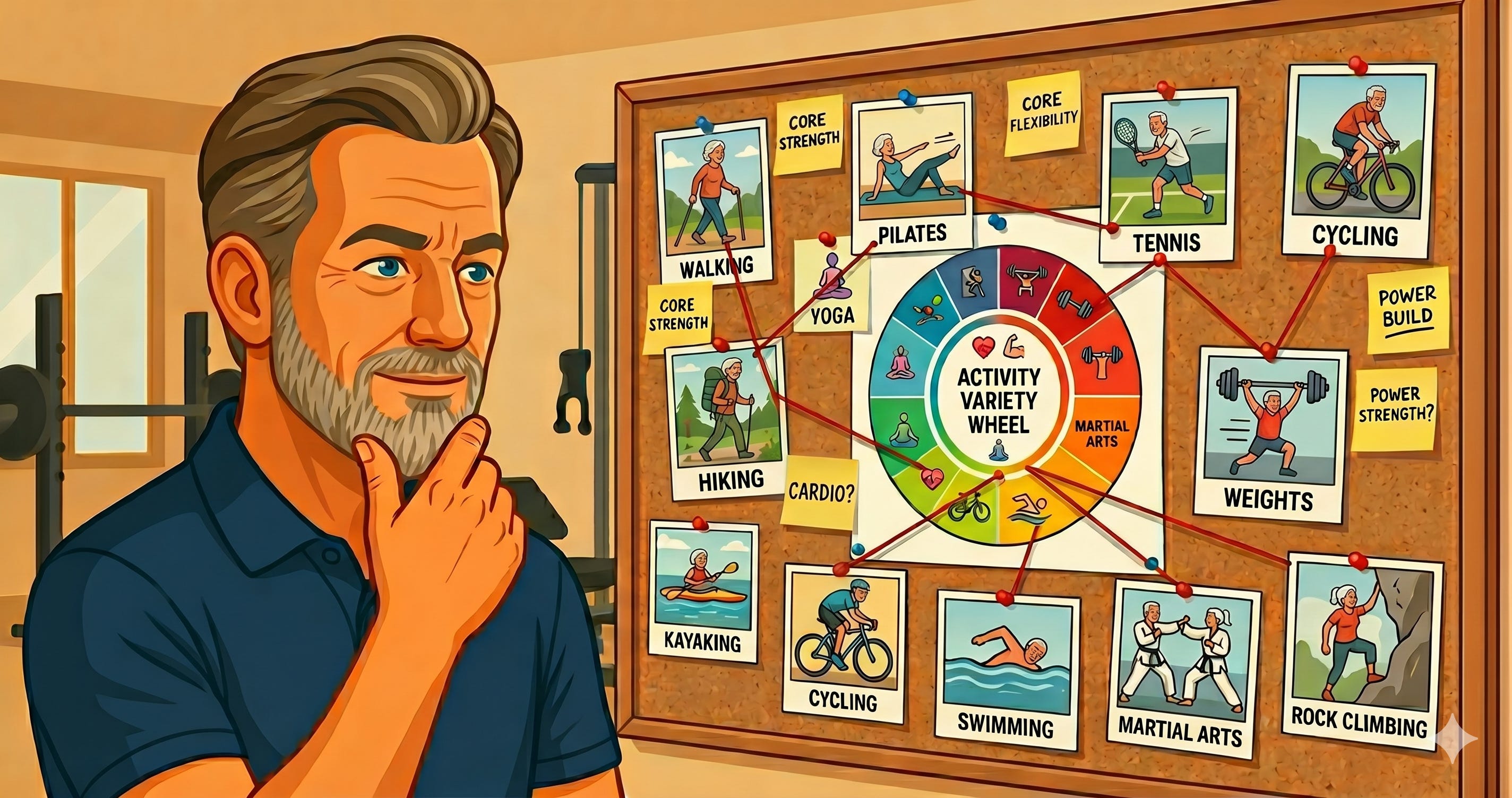
For years, official physical activity advice has occupied that awkward territory somewhere between gentle encouragement and a disappointed PE teacher.
Move a bit more. Walk when possible. Maybe do some gardening. Perhaps twiddle a resistance band while watching Cash in the Attic.
But a recent study published in BMJmedicine suggests something rather more interesting.
Researchers followed more than 110,000 adults over three decades and found that people who did a wider variety of physical activities tended to live longer than those who stuck rigidly to one thing.
Not necessarily more exercise. Not harder exercise. Just more variety.
Which, when you think about it, feels fairly logical.
Human beings seem to do quite well when we move in a variety of ways rather than becoming black belts in StairMaster alone.
The researchers called it a ‘variety effect.’
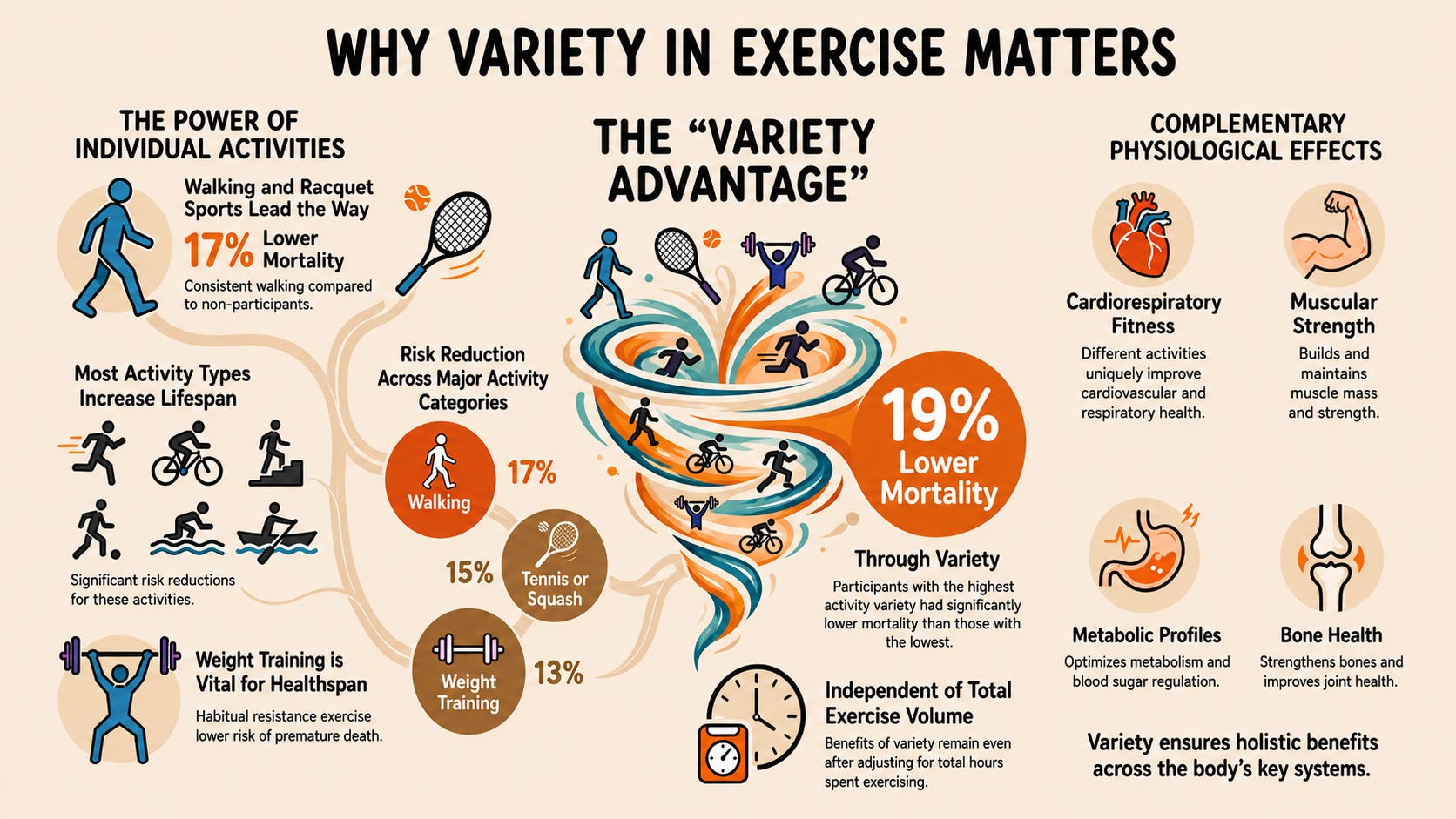
People who mixed things up — walking, weights, cycling, stretching, racquet sports and similar activities — had a noticeably lower risk of dying during the study period compared with people whose movement habits were much narrower. Even when overall exercise time looked broadly similar.
In simple terms: variety really may be the spice of life when it comes to movement.
Remember - Like all observational studies following people over decades, they show association, not direct causation.
Not all activities were equal, though
Some of the findings were slightly odd.
Walking performed brilliantly yet again. Once more, the humble walk quietly outperformed far more glamorous forms of exercise while requiring absolutely no investment in Lycra or hydration vests.
Racquet sports also came out looking extremely impressive. Which actually makes a lot of sense when you think about it. They combine bursts of intensity, coordination, balance, reaction time, decision-making and the occasional argument about a dubious line call.
Swimming, surprisingly, didn’t show much benefit in this analysis.
That raised a few eyebrows because swimming is normally presented as the ‘school prefect’ of physical activity. Sensible. Reliable. Well behaved. The researchers suspect the way activity was measured may explain some of this rather than chlorinated water suddenly becoming kryptonite for fitness.
How much still matters
Another striking finding: benefits appeared to level off after a moderate amount of activity rather than climbing endlessly upwards.
Good news for anyone concerned that healthy ageing required spending retirement doing hill sprints while eating industrial quantities of tofu.
Quite how this fits alongside a newer study suggesting we may need far more weekly exercise than the current guidelines recommend is one for scientists to wrestle with. Well above my pay grade.
The broader message here feels refreshingly practical.
You probably don’t need one perfect exercise programme.
You may simply need a decent-sized movement menu to choose from.
Walk. Lift heavy things. Climb stairs. Stretch occasionally. Ride a bike. Swim if you enjoy it. Play tennis badly. Garden like you mean it.
Personally, I’ve always struggled with doing the same activity over and over again. I have the attention span of a Springer Spaniel at the National Squirrel Convention, so variety and novelty are usually the things that get me out the door.
Fitness, to me, is essential self-maintenance. But my real love has always been chasing a ball with a bat, paddle or racquet.
Turns out nature seems to approve of a jack of all trades.
Putting it into practice
These studies are all well and good but the question then is how to use these findings in real life?
The answer is to start by thinking less about the ‘perfect’ routine and more about collecting different, but balanced, forms of movement across the week.
Try to include:
Something cardiovascular — walking, cycling, rowing, jogging
Something strength-focused — resistance training, bodyweight exercises, carrying heavy shopping like a pro
Something involving coordination, balance or reaction time — tennis, pickleball, dance classes, padel, table tennis
You don’t need to tick every box every single week.
The study looked at consistent participation over time, not a weekly bingo card of activities.
You might walk most days, lift weights twice a week, play tennis occasionally and take the stairs whenever possible. That already gives you a varied palette to work with. It’s also useful insurance against overuse injuries. A nice bonus.
It’s also worth rotating activities according to how you feel.
If your legs are grumbling after a long walk, perhaps do upper-body work the next day. If you feel mentally frazzled, maybe skip the structured workout and go for a walk instead.
The aim isn’t exhaustion. It’s sustainable variety.
And from a healthspan perspective, that may matter more than becoming fanatically good at one single thing.
It looks like the future belongs to Hybrid Seniors.
To join the club you’ll need to do three or more activities a week.
Lycra optional.
Let me know which activities are on your menu in the comments.
Cheers 👋
Stuart
Medical Disclaimer: This article is for general information only and does not constitute medical advice. The needs of every reader are unique; please consult your GP or a qualified healthcare professional before making changes to your diet, exercise routine, or medication. Never ignore professional medical advice because of something you read online.