

The Truth About Your Legs in 30 Seconds
Your legs are your retirement plan for an independent future. Start investing now, with just 30 seconds.

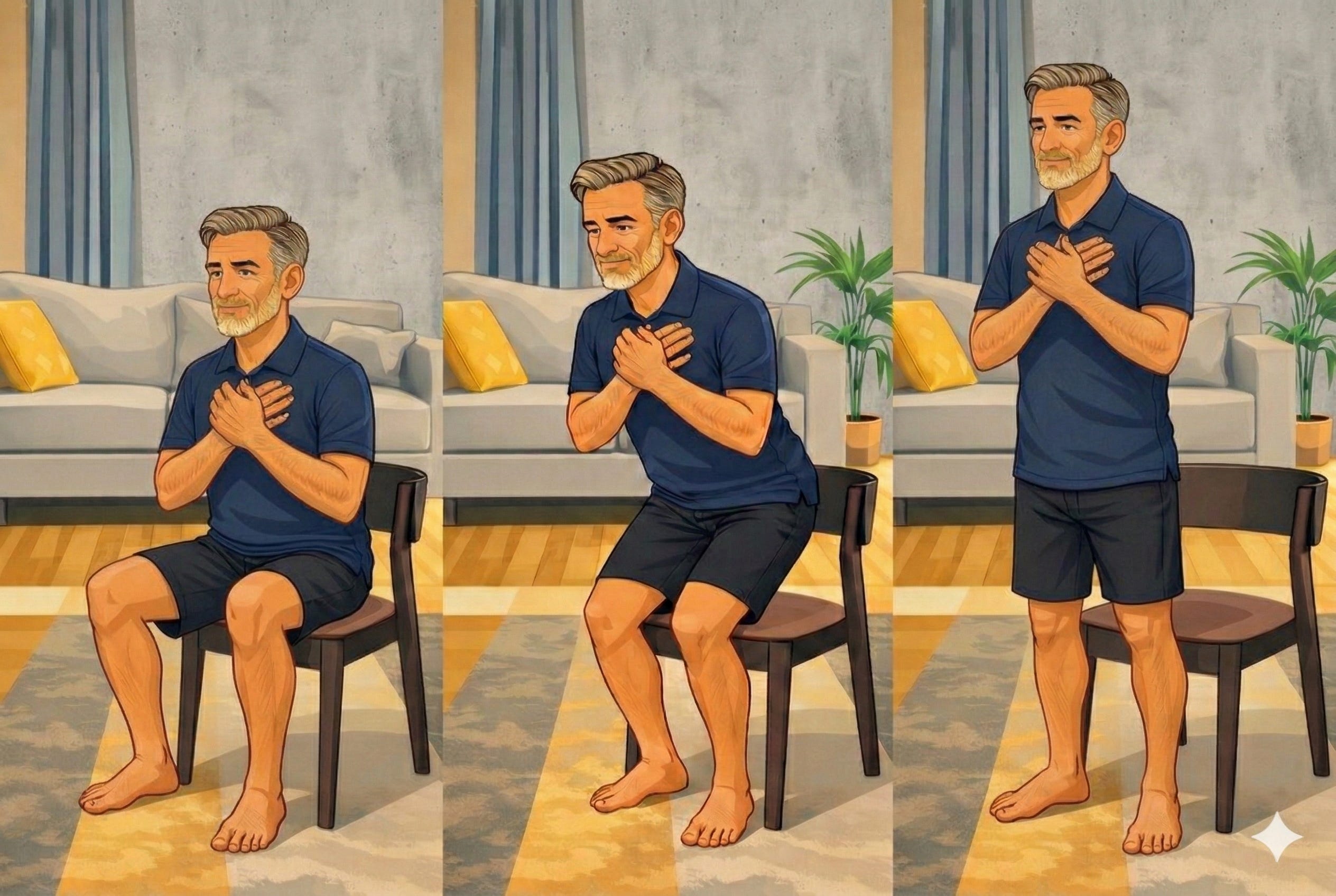
You’re likely debating whether to try this or keep scrolling. That hesitation is where most plans quietly fade. If you’ve ever felt stuck at the starting line, you’re not alone. Taking that first step is always the hardest part. In fact, If you’re sitting in a chair right now, you’re already halfway there.
A smart investment in your future self
This challenge takes just 30 seconds and focuses on one of the most critical pillars of healthspan: muscle.
The 30-second sit-to-stand test. It’s one of the most revealing ways to see how your body is holding up over time. What looks like an everyday movement hides a vital metric: lower-body strength.
Why this test matters
As we age, a quiet downgrade happens in the background.
After the age of 60, adults can lose around 1–2% of muscle mass per year, and strength may decline two to three times faster than that.
Doctors call it sarcopenia — the gradual loss of muscle mass and function. Left unchecked, this can often lead to early disability and loss of independence.
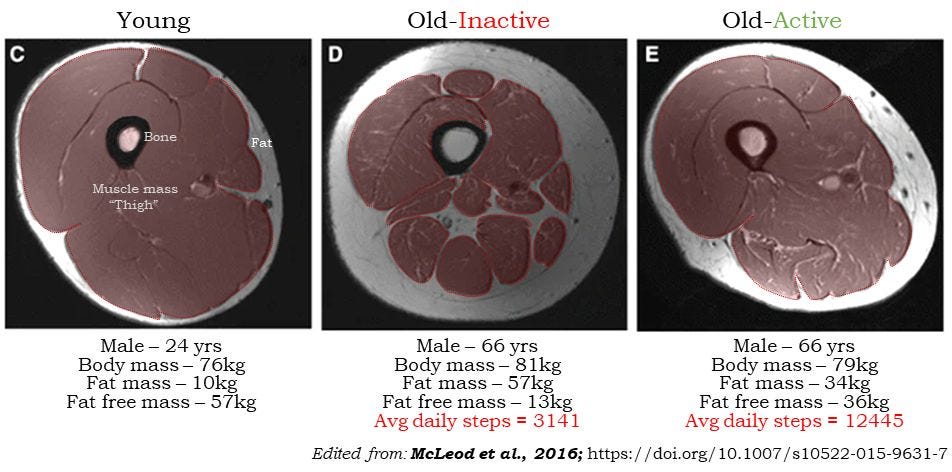
Leg strength underpins almost everything in daily life.
Getting out of a chair.
Climbing stairs.
Carrying the shopping.
Avoiding an undignified encounter with the pavement.
For such a simple test, researchers like the fact that it can provide useful information about:
Power
Balance
Functional independence
Researchers have also found that the sit-to-stand test is a surprisingly good indicator of:
Walking speed
Frailty
Ability to perform daily activities
In short, those 30 seconds tell you exactly how well your body is coping with the passage of time—and what your future might look like if the trend continues.
If you’d like more simple ways to test and improve your healthspan, subscribe to Olderland. Each week, I share practical steps that take only a few minutes but can pay dividends for years.
Ready to find out where you stand?
Before reading further, decide where you’re going to do this.
A kitchen chair with no arms will do nicely.
Stand up, grab your phone for the timer, and come back when you’re ready—no Lycra required.
Note: Please skip this test if you have knee pain or mobility issues. This one isn’t for you.
How to do the test
Setup:
Position the chair with its back against a wall so it can’t move. If you feel unsteady, place a second chair next to you for support.
Sit on the chair with your back straight and your feet flat on the floor.
Cross your arms over your chest and keep them there. Don’t use your hands or push off with your arms or knees when standing up.
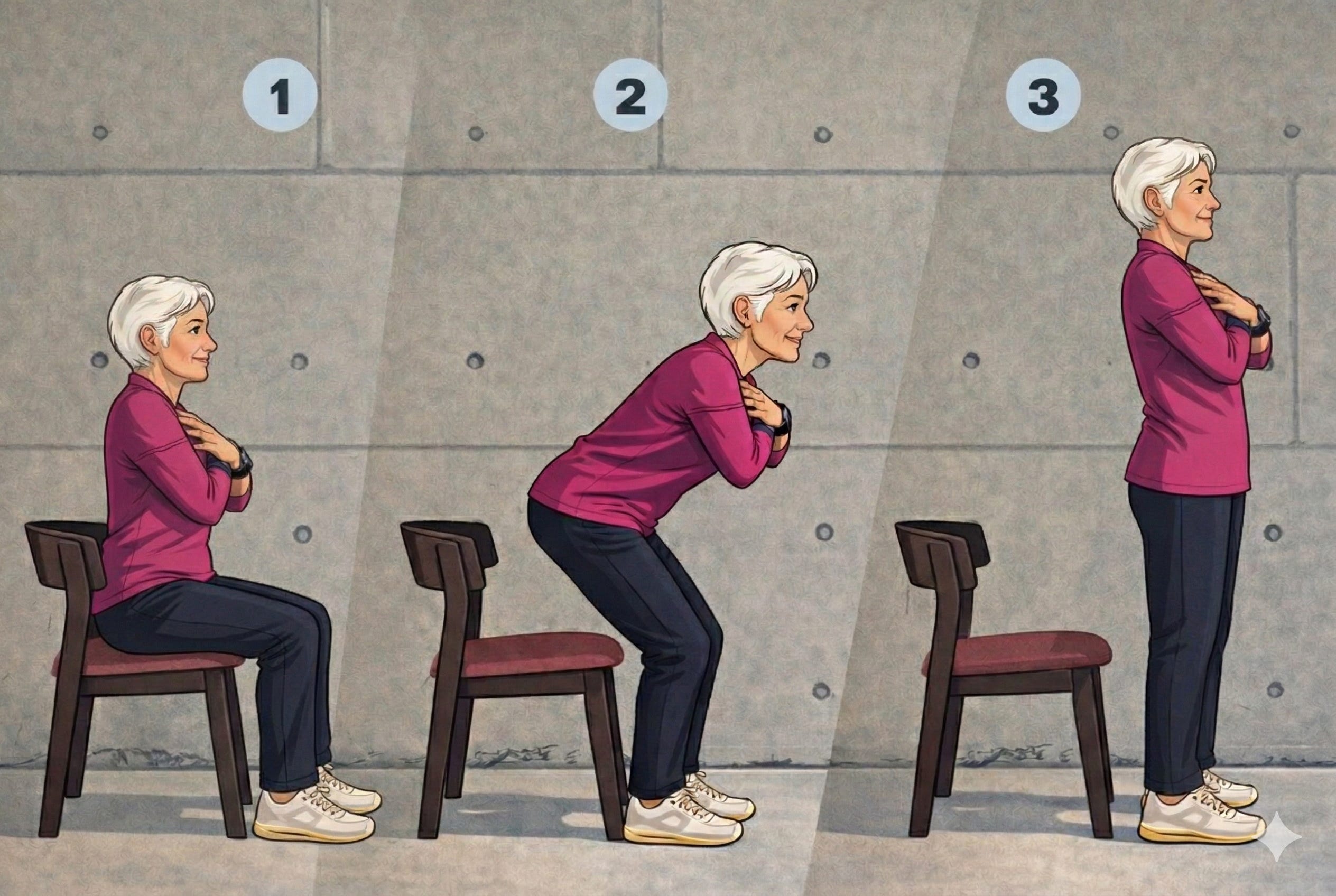
The test:
When ready, start the timer.
Stand up completely from the chair, keeping your arms crossed.
Sit back down fully on the chair.
Continue standing up and sitting down as many times as possible within 30 seconds.
Count each complete down-and-up repetition.
If you’re in the process of standing when 30 seconds ends, count that final repetition.
Make a note of the total number of full repetitions.
Making sense of your score
Researchers measured thousands of people to establish typical scores by age and sex.
So what counts as “good” for your age? Compare your score with the chart below.
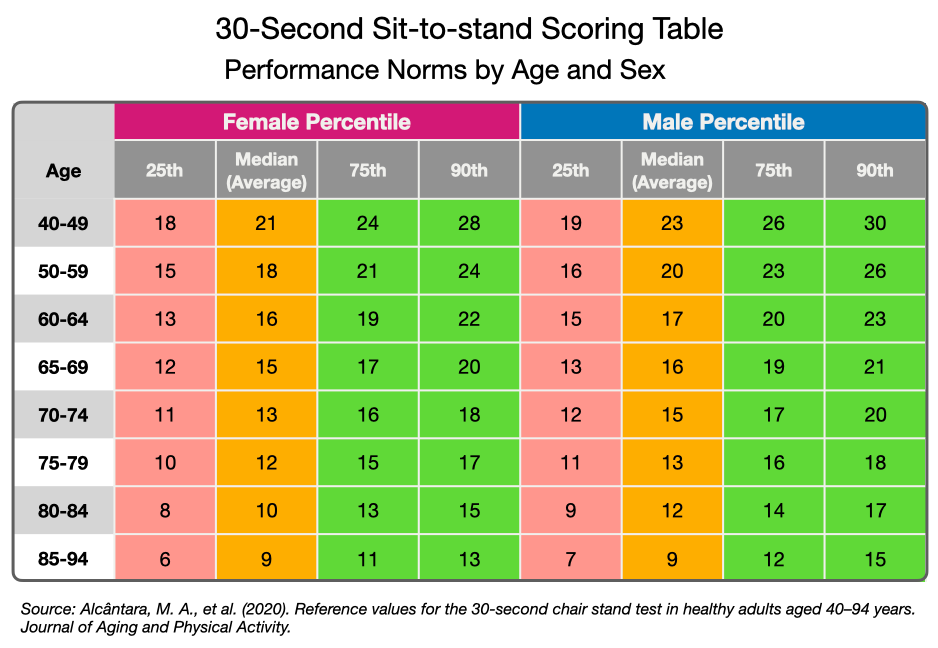
A median ‘average’ (50th percentile) score would be typical for your age group. The higher your percentile, the better your legs are performing.
Younger legs in an instant
You may even discover you have ‘younger’ legs than your actual age - here’s how.
Take your score and find the closest to the average for a particular age band. For example, a 70-year-old man completing 17 repetitions would sit around the 75th percentile for his age — but roughly match the average performance of a 60–64-year-old.
Not bad going.
A higher score means you have a larger functional reserve — a bit more strength “in the bank”. In practical terms, that means greater capacity to handle the demands of daily life and the occasional emergency.
Those in the lower percentiles tend to have reduced capability and a less robust physical future.
Someone in the 90th percentile would be exceptional for their age group.
Whatever your score, this is your starting point for improvement.
The message is straightforward:
Use it or lose it.
These aren’t “pass or fail” marks. Think of this as a quarterly status update.
What’s more important is how your score changes over time.
Your Olderland Weekly Challenge
The beauty of this test is its convenience and practicality.
This isn’t “gym strength”; it’s real-life strength.
The ability to get out of a chair is the gateway to independence.
Don’t overthink it: Most people reading this could do the test in the next two minutes..
No heroics required. Just 30 seconds of feedback from your legs.
No matter the result, you’ll know exactly where you stand—pun intended.
In future posts, I’ll show you how I work on this pillar of healthspan, and how you can too, without needing to become a super-athlete.
In the meantime, for the next 7 days.
Every time you sit down, stand back up and sit down again — do a double sit.
If the research is right, we perform around 50 sit–to–stands in a typical day, plenty of opportunities to get your pins pumping!
Your future legs will thank you.
If you try the test, and you’re in a sharing mood, post your score in the comments. I’ll start the ball rolling. (65-year-old male - 20 repetitions)
Medical Disclaimer: This article is for general information only and does not constitute medical advice. The needs of every reader are unique; please consult your GP or a qualified healthcare professional before making changes to your diet, exercise routine, or medication. Never ignore professional medical advice because of something you read online.